Yanis
I’ve just turned the last page of Talking to My Daughter About the Economy by Yanis Varouvakis.
I’ve long admired Yanis and he’s good authorial company in this book but I ultimately found it a bit thin, especially when compared to other popular books with similar remits (Filthy Lucre by Joseph Heath being my fave).
I have a special dislike of the Guns, Germs and Steel narrative of history and I think it has influenced Yanis’ writing for the worse. I don’t see how anyone can believe in the inevitability of geographic determinism while also being an activist with “resistance is never futile” as a personal motto. Sorry Yanis. I still love you.
Anyway, Yanis does have a certain Escapological sensibility that I thought I’d share with you all today. Towards the end of the book (shortly after a sub-chapter called “Escape Hatch,” oddly enough) he writes:
Something that angers and terrifies me more than almost anything else is the thought of being the plaything of forces and people of which I am oblivious.
and
The worst slavery is that of heavily indoctrinated happy morons who adore their chains and cannot wait to thank their masters for the joy of their subservience.
I just wish he’d more successfully squared this libertarian streak with the broader socialist/democratic moral of the book. That is the challenge for intellectual Escapologists.
Begin With the End in Mind
I’ve never read Stephen Covey’s The 7 Habits of Highly Effective People. It looks too long, too managerial, and generally like something Rimmer would read.
Doubtless it’s the sort of book to contain the odd gem or an interesting way of seeing a problem, but this is an effect that leaves me feeling like a gold prospector sifting for nuggets.
(This is precisely how I felt about the famous Getting Things Done when I finally read it last year. In this instance the useful nugget was the word “trusted”).
The 7 Habits was hugely influential and contributed significantly to the tone of modern self-help so it gets mentioned a lot. When it was came up today I found myself wondering what exactly those seven (sorry, “7”) habits are exactly so I looked them up.
Aside from the annoying discovery that I’d independently come up with Covey’s abundance mentality rather belatedly, the best truth nugget lies in the second habit: “Begin with the End in Mind”.
This struck me first as a bit “well, duh” but then it hit me like a suckerpunch.
It had never occurred to me that many people (perhaps even most people?) do not “begin with the end in mind”.
Suddenly, the behavior and decisions of so many people I’ve met over the years made sense. People who binge as soon as pay day rolls around. People who think that checking themselves into wage slavery is a sustainable solution. People who hoard. People who are disorganised. Above all, people who discount the future.
You can probably see how this applies. For example, if someone in receipt of a £1,500 pay cheque had a reasonable, pragmatic, non-punishing idea of how they want their finances to look by the end of the month (e.g. all bills paid, a reasonable amount spent on fun, a minimum of £300 left over for savings) then they wouldn’t start pissing the new income so spectacularly up the wall on Day One.
In the case of being disorganised, I’d sometimes look at a spreadsheet put together by a colleague — multiple sheets scattered across a single workbook, coloured cells, bold text, complicated filters, cells formatted so that phone numbers can’t begin with a “0” — and wonder about the decisions that led to such a mess. I’d think “is this what you wanted your system to look like?” I mean, it didn’t just happen: you clicked on “bold,” you put weird formatting on those cells.
And man oh man, does this apply to minimalism. “Have nothing in your homes that you do not know to be useful or believe to be beautiful,” is the maxim. Having nothing in one’s home except for the useful and the beautiful is the “end” one must “have in mind”. So when looking at the range of lovely products available to buy, or when given a gift or presented with the opportunity to take something for free, one needs to wonder if it contributes to or detracts from that end.
Some of us probably do this instinctively, but many, I suspect, do not. Covey writes:
It’s incredibly easy to get caught up in an activity trap, in the busy-ness of life, to work harder and harder at climbing the ladder of success only to discover it’s leaning against the wrong wall. It is possible to be busy — very busy — without being very effective. People often find themselves achieving victories that are empty, successes that have come at the expense of things they suddenly realize were far more valuable to them.
It’s sort of bizarre that people fall into this trap so often (or, if we’re being brutal, at all). It’s as though they haven’t worked out that actions have consequences (or that the desirable consequences require specific actions) and instead allow their listing autopilot to drift them into a tempest or throw themselves into performing a host of unhelpful, unrelated actions. Why?
I had an idea a few months ago that I’d quite like to live among a few leafy houseplants so that I might feel a bit more like a monkey in Rousseau painting. What I did next was visit a florist where I acquired a couple of leafy houseplants and I took them home. What I did not do was enlist in a dance class, rub my body down with a prone Cocker Spaniel, or ring up the Natural History Museum to complement them their famous sauropod skeleton. The reason I did not do these things is because they had nothing to do with my envisioned “end” of living among leafy houseplants.
If I found myself performing all of those crazy actions “in pursuit” of fulfilling my house plant ambition, I’d like to think that at some point I’d stop the madness and say “Why am I doing this?”
Which is a good question to ask oneself quite often, really.
Maybe a fault in Escapology is that it assumes people tend to function with an end in mind where, in fact, so many do not.
★ Please, please, please support New Escapologist on Patreon. I’d like to write more essays of substance.
Footage of a Man Dropping a Potato

I just watched a Channel 4 documentary called How to Retire at 40. Wow. I recommend watching it, not because it’ll tell you how to retire at 40, but to because it’s a useful reminder of how bad regular television can be.
Aside from the occasional digital box set (Mr Robot, Twin Peaks) and cherry-picked YouTube show (Best of the Worst, Binging with Babish), I’ve not consumed much in the way of telly over the past decade. This is because television is WOMBAT and, unless you genuinely love it, a distraction from the good life. There are better, cheaper, more intelligent ways of doing nothing.
In this programme, a trio of grinning, boggle-eyed presenters who speak up-and-down and up-and-down patronise the audience and their interviewees and give something like 10% content to 90% waffle — intros, recaps, rhetoric, point-laboring, commercial break, establishing shots of Wolverhampton and footage of a man dropping a potato. The actual message (that we “super save” or “trend spot” to escape the rat race) is so cursory as to be barely useful at all.
There’s a great moment when one of our gurning tellyfolk asks a young business owner how quickly she made her seed capital through crowdfunding (possibly crowdcube, though we’re never told). The answer is nine days, to which the presenter says something like “I’m really sorry, I’m going! Because this is a waste of my time, working in television!” She says it as a joke when she should have said it in earnest. And then done it.
Never forget the bad old days. Escapologists should try getting a bus during the rush-hour commute every so often or eating at Pizza Hut or, in this case, watching television. Just to remind ourselves that shunning these relatively normal pastimes is far from missing out. FOMO be damned!
★ Support New Escapologist on Patreon. Thank you.
An Escapologist’s Diary. Part 50.
Sorry for not blogging in a little while, lovely readers. I’ve been very lazy and — aside from writing the latest New Escapologist essay — have taken almost a month off. I highly recommended it.
We spent a couple of weeks holidaying in Montreal. It was good to be back in my second home and my wife’s first home. What can a young body do in such beautiful surroundings other than lounge on terasses and balconies and on the lush, green mountain? Very little is what.

We were there ostensibly for my brother- and sister-in-law’s wedding, which they had outdoors in the sunshine followed by a great party indoors with lots of good-quality booze. In fact, it was too much good-quality booze in my case, and I had to mysteriously absent myself from the family brunch the next day.
Later in our stay, we popped into the McCord Museum for an exhibition of original magic show posters. I expertly and repeatedly told my companions that this was the very site on which Houdini — the Master Escapologist, about whom I should know everything by now — took the punch to the guttywuts that would kill him a day later. Not only was I certain of it, I was also sure this fact would be the lynchpin of the whole exhibition. In the event, it was mentioned only at the very end of the show that Houdini was in fact walloped at the no-longer-extant Princess Theatre on St. Catherine Street. How could I have been so wrong? I hope my pub quiz team don’t hear of this or I’ll be ritually (and rightly) paddled for this failing in my special subject.
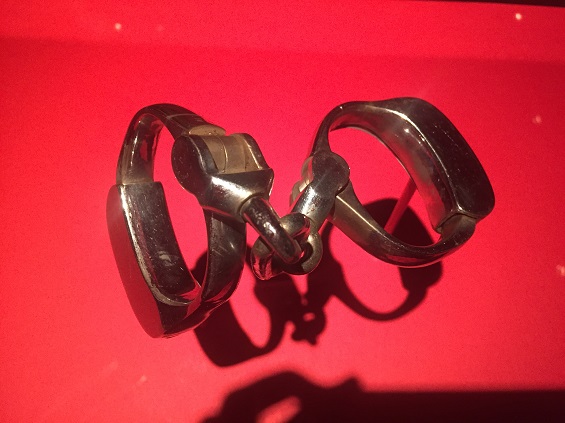
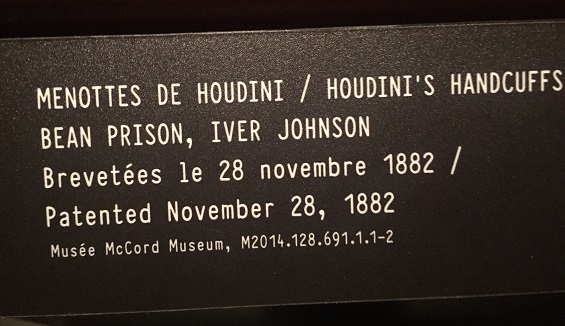
I was, at least, happy to see a pair of handcuffs used by the Master (labelled “Houdini’s handcuffs” as if he had a favourite pair – in fact he usually took regulation cuffs from local police officers) patented exactly a century before my birth. Cool.
It was very good to be back in this dreamy little island city and I wondered why on earth we ever came back to grey old Scotland. But then I remembered the harsh Montreal winters and how I missed all my friends and how it’s useful to make money every now and then. Bugger.
No sooner were we home in Glasgow did we have to hop on a train to London so I could record one of those online courses for the Idler Academy. It was a nice day of recording in the lovely surroundings of a beagle-filled house on the Thames. As you can see, I worked really hard that day. I’ll let you all know when the course is available (because I’m contractually obliged to).


Also in London, we peeked in at the famous Cereal Killer hipster caff on Brick Lane (where, as we sat in the window, a man selling ice cream from a bicycle-and-cart tutted disdainfully at the absurd cereal restaurant before gaily shouting “ice cream!” from his bicycle seemingly oblivious to the irony) and visited the brilliant Queer British Art show at the Tate (where one of the lovelier paintings, it must be said, is on loan from Glasgow’s Kelvingrove Gallery and we can happily see it whenever we like) and took a pointless but long-anticipated legend-tripping pilgrimage to the actual site of the Enfield poltergeist haunting. Oh! And I was stupidly excited to see the Pesticles statue at Hammersmith.
Home now and fairly knackered. Another month off might beckon.
★ If you’d like to re-live the glory days of New Escapologist, please pledge to my Patreon campaign to immediately access 4 new essays (and 4 dusted-off classics) as well as getting a brand new essay at the end of this month. Thanks!
Escape Everything! The Missing Bibliography

A few people said Escape Everything! should have contained a bibliography. I’m sorry it didn’t. Since I’d usually name the book or article I was talking about in the main text, I didn’t immediately see a need for a bibliography. But this overlooked the usefulness of having them all in one place and missed the opportunity to talk about books, which is quite unlike me. So here it is: the missing bibliography. It’s thorough but not comprehensive, itemising the widest shoulders I stood on and pointing to further reading. Still, I hope it’s useful and fun. Most of the links go to Worldcat which can help you to find a local library copy. You can buy most of them in the usual places. I’m also happy to discuss these books or provide extra detail in the comments.
Introduction
The Houdini biography alluded to is The Secret Life of Houdini (2006) by Larry Sloman and William Kalush. Details on Lulu the vanishing pachyderm come from Hiding The Elephant: How Magicians Invented the Impossible (2003) by Jim Steinmeyer. The quote from Adam Phillips comes from his book Houdini’s Box: On the Arts of Escape (2002). For some printed Simon Munnery, I recommend his little volume of aphorisms How to Live (2005) and my own history book about his early work You Are Nothing (2012). Grayson Perry wrote a good book called The Tomb of the Unknown Craftsman (2011) and another called Playing to the Gallery (2014). Myles na Gopaleen is the Irish Times pseudonym of Brian O’Nolan (AKA Flann O’Brien), his finest peluche collected in The Best of Myles: A Selection from Cruiskeen Lawn (1968).
Chapter One: Work
Bob Black’s wisdom comes from his essay The Abolition of Work (1985) and is essential reading. The Buckminster Fuller quote comes from an article in New York magazine (1970). David Graeber’s popular essay On the Phenomenon of Bullshit Jobs comes from Strike! Magazine (2013). The “Richard Scarry” quote from Tim Kreider is in The Busy Trap, New York Times (2013) and also inspired a nice cartoon by Tom the Dancing Bug (2014). My history of work material came from many places but one short book I recommend is The Working Life: The Promise and Betrayal of Modern Work (2000) by Joanne B. Ciulla. Notes from Overground by Tiresias is an amazing book, giving the account of an intelligent person’s life in commuter hell.
Chapter Two: Consumption
The idea that your consumption is someone else’s work and the business about a country’s GDP comes from Enlightenment 2.0. (2014) by Joseph Heath and perhaps also his earlier title Filthy Lucre (2009) which delivers in its promise to give “remedial economics for people on the left.” Small Is Beautiful: A Study of Economics as if People Mattered (1973) by E.F. Schumacher is a core text of alternative economics. The prediction of a 15-hour work week comes from Economic Possibilities for Our Grandchildren (1930) by John Maynard Keynes, but I found it through How Much is Enough?: Money and the Good Life (2012) by Robert and Edward Skidelsky. Bea Johnson’s blog can be found at zerowastehome.com. Enough: breaking free from the world of more (2008) by John Naish is a very inspiring book about living within one’s means. The Music of Chance (1990) is an absurdist novel by Paul Auster and contains all that wonderful stuff about debt, labour and thankless wall-building.
Chapter Three: Bureaucracy
The detail about “International Business Machines” comes from IBM and the Holocaust (2001) by Edwin Black. Green MP Caroline Lucas’ book is called Honourable Friends?: Parliament and the Fight for Change (2015) and is marvellous and must be read before parliament is reformed and it goes out of date!
Chapter 4: Our Stupid, Stupid Brains
The Road to Wigan Pier (1937) and Coming Up for Air (1939) by George Orwell are both essential reading for free thinkers; the former being a collection of journalism on working-class life, and the latter an absorbing novel about nostalgia and the present. Sartre’s idea of Bad Faith is articulated in Being and Nothingness (1943), which is barely readable and best avoided, perhaps in favour of his novel Nausea (1938). Roald Dahl discusses his life as a Royal Dutch Shell employee in his memoir Going Solo (1986). Steven Pressfield’s The War of Art is that neat little book about Resistance. David Cain’s wise essays can be read for free at Raptitude.com. Brian Dean’s great website lives at anxietyculture.com and he also wrote a nice article, “Escape Anxiety,” in New Escapologist Issue 3 (2009). Alain de Botton’s Status Anxiety (2004) is essential stuff, especially the “thesis” page and the Bohemia chapter. Mark Fisher’s essay is called “Suffering with a Smile” and appeared in The Occupied Times (2013). Tom Hodgkinson’s How to be Free (2006) is the most essential reading of all and his How To Be Idle (2004) and Brave Old World (2011) are good too. Musings on the prisoner’s dilemma comes from Andrew Potter and Joseph Heath’s The Rebel Sell (2004).
Chapter 5: The Good Life
The Kama Sutra is an ancient Indian text on the good life, a goodly portion of which is dedicated to rutting. Lin Yutang is the writer of, among other works, The Importance of Living (1937), which is highly readable and worth your time. Much has been written on Eudaimonia and the core texts are probably Aristotle’s Nicomachean Ethics and Eudemian Ethics. The stuff about consumers versus appreciators comes from Happiness: A Very Short Introduction by Daniel M. Haybron (2014). Palliative nurse Bronnie Ware’s Regrets of the Dying is a blog post from 2009. For more on Epicurus I refer you again to Status Anxiety (2004) by Alain de Botton. For more on the Stoics try A Guide to the Good Life: The Ancient Art of Stoic Joy (2009) by William B. Irvine. I make brief reference in this chapter to The Urban Bestiary: Encountering the Everyday Wild (2009) by Lyanda Lynn Haupt, The Cloudspotter’s Guide (2006) by Gavin Pretor-Pinney, both of which are worth a look, and Look Up Glasgow (2013) by Adrian Searle. For books to get you excited about astronomy, you can’t go wrong with Cosmos (1980) by Carl Sagan or some of the amateur astronomy introductions by Patrick Moore. I make passing reference to The Fruit Hunters (2008) by Adam Gollner. “The last piece of chocolate in the universe” is the idea of my child self but something similar apparently appears in Savor (2015) by Niequist Shauna. I make an incorrect claim that the 10,000 rule comes from Malcolm Gladwell’s The Tipping Point (2000) when in fact it comes from the same author’s Outliers (2008).
Chapter 6: How Escapologists Use Their Freedom
The crab anecdote comes from an extremely charming work of naturalism and neurology called The Soul of an Octopus (2015) by Sy Montgomery. The quote about Wall Street and toilet cleaning comes from Vagabonding (2002) by Rolf Potts, which is worth reading if you ignore the garbage about working for one’s happiness. The Oscar Wilde quote about “the perfection of the soul within” comes from his essay The Soul of Man Under Socialism (1891). Tom Hodgkinson’s New Escapologist Issue 3 (2009). The concept of “Filling the Void” is well-trodden territory but that phrasing of the problem comes from The 4-Hour Work Week (2007) by Tim Ferriss. The Voyage of the Beagle (1839) is Charles Darwin’s account of his five-year voyage around the world and is surprisingly readable for its age and highly likable.
Chapter 7: A Montreal Year
“That Will Do” is what Houdini said to the McGill University student who punched him repeatedly in the stomach just before he died, a fact that comes from the Houdini biography referenced in the introduction section above. Much wisdom can be found in A Philosophy of Walking (2014) by Frédéric Gros as well as The Lost Art of Walking (2008) by Geoff Nicholson. For approachable natural history, try anything by Gerald Durrell, Leonard Dubkin ad Lyanda Lynn Haupt. Passing reference is made to Robinson Crusoe (1719) by Daniel Defoe and I’d also recommend a novel about it’s author Foe (1986) by J. M. Coetzee. If you’re interested in eating your way to immortality, Fantastic Voyage (2004) by Ray Kurzweil and Terry Grossman is the go-to text albeit a little old.
Chapter 8: Preparation
The quotation from Charles Simic (not Simi – a typo I had nothing to do with) comes from The Monster Loves His Labyrinth: Notebooks (2008). “I never hear the word ‘escape'” is a poem by Emily Dickinson and can be found, strangely enough, in The Complete Poems of Emily Dickinson. The details about Robert Graves’ assertion that there’s no money in poetry comes from Among the Bohemians: Experiments in Living 1900-1939 (2002) by Virginia Nicholson which is essential to read if you’re interested in Bohemian life, though I also refer briefly to his memoir Goodbye to All That (1929). An account of Alexander Supertramp’s life can be found in Into the Wild (1997) by Jon Krakauer. Dandelion Wine (1957) is a lovely if a tad bucolic novel by Ray Bradbury, a quote from which appears in New Escapologist Issue 1. The cancer diaries referred to belong to the library of a hospice I worked in.
Chapter 9: Escape Work
Arbeit macht frei means “work sets you free” and appears in the ironwork gates at the Auschwitz work/death camp, a fact I first learned from If This Is a Man (1947) by Primo Levi. Jacob Lund Fisker’s book is called Early Retirement Extreme (2010) and evolved from his blog of the same name. I make passing reference to an item from The Onion (2015) and another, The Strange and Curious Tale of the Last True Hermit, from GQ magazine (2014). Rob West’s blog charting the progress of his house-building project in British Columbia is called The Hand-Crafted Life. Ben Law’s core work on traditional house-building techniques is called Woodland Craft (2015) and Mark Boyle’s “Moneyless Man” column (2009-10) is archived at the Guardian website. Nicolette Stewart’s item about tiny homes can be found in New Escapologist Issue 8. Walden: Or, Life in the Woods (1854) by Henry David Thoreau is the obvious starting point for anyone considering a life in the woods near their mum’s house. Montreal Martin’s blog is called Things I Find in the Garbage. The interview with Michael Palin referred to is in Idler 37 (2006); I’m in it too, albeit under the wrong name, with a cover story called “Death to Professionalism”. How to Avoid Work (1949) by William J. Reilly is a witty and tricky-to-find-in-shops postwar career manual. Wringham’s escape plan first appeared in New Escapologist Issue 3 (2009).
Chapter 10: Escape Consumption
Mr Money Mustache has a blog of that very name. Diogenes of Sinope can be encountered in Diogenes of Sinope – The Man in the Tub (2013). Some of the practicalities of minimalism were first printed in New Escapologist Issue 3 (2009). Joshua Glenn’s The Wage Slave’s Glossary (2011) is an electric little book and is in fact a sequel to his The Idler’s Glossary (2008).
Chapter 11: Escape Bureaucracy
Roderick Long’s “delusional street person” comes from Just Ignore Them (2004) in Strike at the Root. La Boétie wrote Discourse on Voluntary Servitude (1576) which I came across in the dazzling How to Live: A Life of Montaigne in one question and twenty attempts at an answer (2010) by Sarah Bakewell. Kafka’s The Trial (1925) is the go-to work of fiction for bureaucratic absurdity. Narnia and Bas-Lag are the worlds of C. S. Lewis and China Mieville respectively. I don’t recall where I read about Chiune Sugihara but there’s a nice item about him in the Japan Times (2015). The Pomodoro Technique (2006) is a cute but effective productivity system concocted by Francesco Cirillo.
Chapter 12: Escape from our Stupid, Stupid Brains
Naked Stephen Gough’s point about being good comes from a Guardian (2012) item. The stuff about fear of flying versus rationalism comes from Risk: The Science and Politics of Fear (2008) Dan Gardener. The mags I recommend for longform journalism are The New Yorker, Jacobin and Aeon. Much of my info on the Bohemians of history is from Among the Among the Bohemians: Experiments in Living 1900-1939 (2003) by Virginia Nicholson. Caitlin Doughty is mentioned, whose first book is Smoke Gets in Your Eyes: And Other Lessons from the Crematorium (2014). The Wise Space Baby was originally mentioned in New Escapologist Issue 10 (2014), and the “damning conclusions” drawn by astronauts on the international space station are alluded to in An Astronaut’s Guide to Life on Earth (2013) by Chris Hadfield. The Holmes and Rahe Stress Scale (1967) is a real thing and can be seen on Wikipedia. The stuff about Quat leaves comes from The Devil’s Cup: A History of the World According to Coffee (1999) by Stewart Lee Allen.
Chapter 13: The Post-Escape Life
Henry Miller’s list can be seen in Henry Miller on Writing (1964).
Epigrams
“Love laughs at locksmiths,” comes from a signed photograph of Houdini but has an older origin, featuring on an 1805 satirical print held by the British Museum. The other Houdini epigrams come from Handcuff Secrets (1907), Magical Rope Ties And Escapes (1920), Miracle Mongers and Their Methods (1920), Houdini’s Paper Magic: The Whole Art of Performing with Paper (1922).
★ Escape Everything! by Robert Wringham is available in libraries and was recently republished in paperback.
Escape Facebook
Renegade freak that I am, I deactivated my Facebook account last week.
Life is better without it. Already I feel calmer, happier, no longer irritable or twitchy. I bloody knew coffee and tea were nothing to do with that! Sorry I doubted you, oh lovely cuppa.
You’re all your own bosses, but I’d urge you to leave Facebook too. Read our happiness editor’s thoughts on the subject if need a further nudge.
Rather pathetically, I hesitated for about three weeks before finding the courage to click “deactivate.” I kept turning the possible consequences over and over. Would I become a full-on social outcast? Would I lose precious connections to the past? Is there actually something transcendent to be said for participating in the social network, even if it really is a glorified advertising scam?
I made sure I had alternative contact details for people I didn’t want to lose touch with. In doing so, I was strict about who I’d take with me: part of my reason for leaving Facebook was to shed the 250 people I don’t have any meaningful relationship with. I was only in touch with those people in the hopes that they were “potential future friends” or as egotistical social trophies, neither of which is healthy or right. Maybe I’ll reconnect with these people again one day, but in deliberate and organic circumstances.
I also downloaded my “information” before leaving. I only wanted my photographs but the download also contains old messages and posts. I had a quick look at these and, oddly enough, the first to catch my eye was a friend’s public declaration that he’s “winding up his Facebook account.” This message was about seven years old and the fellow in question is still on Facebook today, posting embarrassing status updates around the clock. This was the final nudge I needed!
Doubtless, it’ll be a pain in the arse for a while because almost everyone’s on Facebook, making it a super-convenient directory of humanoids (a “Face Book” even), but ubiquity is just another thing to dislike about it. Facebook is humongous while small is beautiful.
Not that it’s essential to be on a social network at all, but an appealing Facebook replacement might be Ello, a burgeoning ad-free, neatly-designed alternative. It doesn’t come from greedy, world-dominating Silicon Valley but from a bike shop in friendly Burlington: a town I’ve been to and which struck me as lovely.
Ello seems fated to become the betamax of social media: superior to its competitor but failing to win popular traction. But it doesn’t matter. It’ll work for the people who use it. A social network doesn’t need approval from everyone to work. Invite your ten best friends to Ello–the people you actually want to hear from instead of the 300-strong rolodex your Facebook has become–and it’ll work for you. It doesn’t matter what the majority are up to.
In any event, escaping Facebook has been an end in itself. It feels good to have let go. I feel like I’ve passed a gallstone or something.
I’ll now get news from less-dubious reliable sources, accidentally click fewer Daily Mail links, expose myself to less anxiety-producing litter, and talk to friends in more personal ways.
Here’s Tom Hodgkinson on the subject:
Facebook is another uber-capitalist experiment: can you make money out of friendship? Can you create communities free of national boundaries and then sell [crap] to them? Facebook is profoundly uncreative. It makes nothing at all. It simply mediates in relationships that were happening anyway.
★ Tired of the everyday grind? Pre-order the New Escapologist book today.
Letters to the Editor: The Weird One
Our print magazine doesn’t have a “letters to the editor” section. I long ago chose to shun the usual magazine ephemera (news, reviews, letters, ads) in favour of evergreen essays, opinions and stories.
I stand by this decision because it means our content can properly engage instead of distract, and also that our mags are still readable and relevant long after publication.
Still, I sometimes wonder if a “letters to the editor” section wouldn’t provide a sense of community around New Escapologist. It would confirm that there are other Escapologists out there: some successful, others struggling, but all with the shared and uncommon tendency to take escape seriously.
Well, luckily we have the blog. If you’d like to submit a Letter to the Editor, feel free to get in touch. Just let me know if you’re happy for it to appear on the blog.
Here’s our first LttE.

Good morning/afternoon Rob,
I’m extremely excited to dive into the back issues. I’ve been a follower of your blog for some time and have experienced a complete 180 in my mindset over the past 1-2 years in regards to escaping it all!
I am actually a Certified Public Accountant in the USA located in one of the wealthiest parts of the country. The way I was raised and the things I have noticed as I’ve matured have caused me to rethink my whole mentality and what it means to “Live the American Dream”.
Seeing countless “wealthy” individuals in my hometown driving the luxury automobiles and building the $1-million+ mansions, all the while being shackled to creditors and ultimately their desks, has forced me to rethink my direction in life and strive to focus on something more fulfilling than punching the time card, taking a paycheck and keeping up with the Joneses.
Thankfully, I have been able to share my new attitude with many of my friends and colleagues in the hopes of helping them to revamp their total fiscal mindset (and not the typical tax advice that a larger mortgage/interest helps for taxes).
However, as I’ve become more open about my thoughts, plans, new mindset, I’ve met with a strange reaction. I’m being perceived as the “weird” one! It has actually been completely entertaining to see people’s reactions and their defense of the current system.
Anyway, I’m sorry to ramble. My point is that I am excited to read more and would be very interested in helping you and/or contributing to your mission if there is a need. I am not looking for compensation, only for a way to express my thoughts and research and/or to help refine others’ similar thoughts/research.
Thank you again,
L
Dear L. Thank you for writing in. I like the quotation marks you put on “wealthy”, especially given your job as an accountant to the American rich. Since coming to Canada, I’ve met a lot of these “wealthy” suburban types and it’s hard to see how they’re anything of the sort. If they’re in debt to creditors, it doesn’t matter how big or well-appointed their house is. Surely purchasing power isn’t the same thing as wealth, even in the world of finance. It can’t be healthy. For my sins, I went to an event at the Ritz recently and rubbed shoulders with multi-millionaires. They’re all insane, incapable of intelligible conversation or even dressing themselves properly. I can only imagine they’ve been driven mad with anxiety over the vast sums of credit (Mirror Universe money) they’re handling.
★ Tired of the everyday grind? Pre-order the New Escapologist book today.
Canadian Hermit
And here’s one last thing about hermits, if you can take it. A silly piece I wrote in my personal blog this spring:
“Sorry brain, back in the freezer.”
This is what I say when it’s time to go out in the Montreal winter. At -30°C, you become aware that your physical brain might not be having a terrific time.
That’s not really acceptable in the civilized world, is it? You should never be put in a situation where you’re moved to apologise to your brain.
When my brain didn’t complain about the cold today, I felt genuine concern. Had it died? Had Quebec murdered my brain?
No. Something was different. The snow was melting. Green buds had appeared on the trees. All around, I could hear the rumbling tummies of a million defrosted tardigrades.
Were we above zero? Spring! Spring was here!
“Spring is here, old woman!” I said to an old woman.
“Va chier,” she said (or in English: “Rejoice, rose-cheeked young sirrah!”)
“Spring is here, bedraggled pigeon!”
“Coo,” said the pigeon, perched on a plastic owl.
“Spring is here, plastic owl!”
The plastic owl looked pissed off.
A small man with a bushy beard and a red cycle helmet was standing and stinking on the street corner with a can of something called Pabst Blue Ribbon.
On seeing him, I stopped dead in my tracks. Scrotters? It was Scrotters! His presence was as surprising and wonderful as the spring itself.
My instinct was to plant a big wet kiss on his mouth and say “Spring is here, Scrotters, old friend, and–what’s more–I love you!” but kissing a tramp is inadvisable even if you’re a tramp yourself.
Besides, “Scrotters” is probably not his real name, merely the one I’ve rather offensively given him in the privacy of my head.
If only there were some way to learn his real name. But there’s not.
I’d been worried about Scrotters and it was a relief to see him after such a long time. He’d disappeared from his corner four months earlier, mysteriously replaced by a far-stinkier and more aggressive tramp. The new tramp’s secret name was Lion Man because he looked like a lion and ate raw meat.
Lion Man, I imagined, had frightened Scrotters away and stolen his lucrative corner.
I didn’t think the battle for the corner had been too bloody, just that Scrotters had been forced to move along by a trampier tramp. After all, Scrotters had that helmet. He was indestructible.
All the same, I didn’t like Lion Man. When I didn’t give him money, I got the impression he was silently hating me. Scrotters, under the same circumstances, would always growl and call me a shit owl, but there was never any malice in it.
Before his disappearance, Scrotters rarely if ever left his corner, which provided our neighbourhood with a welcome sense of certainty. Lion Man, on the other hand, spent half of his time on the opposite side of the street, spreadeagle on the ground, catching snowflakes.
You never knew what to expect with Lion Man. It was chaos.
Before the tramp replacement, we’d always been able to see Scrotters from our kitchen window. Every morning, his helmet would catch the bleary eye across the granola.
Each day, one of us would remark to the other something along the lines of “Oh look, someone’s bought Scrotters a massive pizza,” or “Oh look, Scrotters is wearing his cross-country skis.”
When I arrived back home today, I was very excited to report to my girlfriend that our favourite tramp was safely back on his corner of choice.
“Scrotters is back!” I said.
“Scrotters?” she said, “Where do you suppose he’s been?”
For a brief moment I wondered if his triumphant return was actually a tragedy. What if Lion Man had been nothing to do with his absence and Scrotters had actually been living in a luxuriously-carpeted house for four months but he’d lost it all again and wound up back on the corner.
“He must be the summer tramp,” I said, dismissing the rags-to-riches-and-back-to-rags-again story I’d witnessed in my head like Captain Picard in The Inner Light, “Lion Man must be the winter tramp.”
“Of course,” she said sarcastically, “Lion Man can withstand the winter because of his glorious mane. Scrotters probably goes down to Florida. He’s a snowbird.”
“See for yourself,” I said pointing out of the window, “One Scrotters.”
There he was. Standing on the corner, as was his way, like a stranded astronaut. A harbinger of spring. Skinny with his red cycle helmet, from this distance he looked like a safety match.
“Are you sure it’s him? Lion Man didn’t nick his helmet?”
“Nah, it’s Scrotters,” I said. “He’s unmistakable.”
“Aw. Prince of Tramps,” she said, finally getting into the spirit of things.
“The Original and Best,” I said.
“Captain Corner,” she said.
“The Pedigree Chum,” I said.
“Can we stop talking about Scrotters now?” she said.
“Okay, I said.”
I was glad he came back though. From now on, I’m going to give him a coin every single time I pass him. I’m also going to pretend I’m a wealthy country gent and that Scrotters is my personal hermit. “Look,” I’ll say to visitors, “look at my hermit.”
And there he’ll be.
★ Help fund the forthcoming Escapology book. Order a copy today
Ambitions
How do you make God laugh? Tell Him your plans.
That’s probably my favourite joke of all time, and I remembered it today while looking through thousands of other people’s life ambitions on a goal-tracking website called 43Things.
That’s right. I am God. Sorry about your funny-shaped head.
43Things is a fascinating glimpse into the minds of humans (or at least the minds of the kind of humans who like to record and monitor their life ambitions).
I’m not really laughing at other people’s ambitions, but as someone who has thought a lot (perhaps too much) about ambition and who has learned to embrace absurdity somewhat, I did feel rather like the God of that joke and couldn’t help but be charmed by many of them.
Look at the all-time top-ten ambitions:
1. Lose weight (41565 people)
2. Write a book (30944 people)
3. Stop procrastinating (30322 people)
4. Fall in love (27197 people)
5. Be happy (24782 people)
6. Get a tattoo (22003 people)
7. Go on a road trip with no predetermined destination (21484 people)
8. Get married (21292 people)
9. Travel the world (21005 people)
10. Drink more water (20255 people)
They’re all perfectly admirable goals, but I’m left thinking “What’s stopping you?” for each of them. I’ve done eight of these ten by accident. If you want to get married, do it. It’s an afternoon.
I’ve identified three main problems with people’s goal-setting techniques:
– Poorly Defined Goals;
– Lack of Ambition;
– Unrealistic or Fantastical Goals;
– Conflicting Goals.
In the case of poorly defined goals, we see things like “Revise my Health Routines” (to what end? in what way?) and “Learn constellations” (How many? All of them? Which pantheon? Which hemisphere?). There’s also an annex to this problem in the form of poorly-phrased goals, which includes things like “installing a new doorbell” (it should be “install a new doorbell” – phrase it as a command and you might actually do it).
In terms of lack of ambition, I refer you again to “installing a new doorbell”. Not really a life goal is it? Or perhaps it is! Perhaps that person has already swum with dolphins or simply doesn’t want to.
But at least a new doorbell isn’t as ill-founded as those goals we can find in the “unrealistic or fantastical category”:
– fly
– be indistructible for a day
– go on a date with Ron Weasley
– be with Jesus
– be queen for the day
– learn to talk with the animals
– own a penguin
– meet a fairy
– wish on a star and have it come true
– learn telekinesis
– time travel
– become a mermaid
– become invisible
– control water
– meet the sandman
Good luck with those! A wonderful thing about this kind of ambition is that the people who have them usually also have quite normal interests alongside them, so “meet a fairy” sits alongside “learn to knit”.
Maybe the fantasists will achieve their ambitions in a weird sort of way. Perhaps the woman who wants to meet the sandman will meet a highly dedicated cosplay guy at a fan convention. To most intents and purposes she’ll have met the sandman. I wouldn’t want to stop these people from living charmed lives.
In the case of conflicting goals, I refer you to the poor fellow whose entries, “end it”, “give up”, and “be forgotten” are a cry for help that could be taken seriously if one of his entries was not also “learn Japanese”.
See also, the gentleman who wants to “be a famous rapper”, “be a famous model” and “walk on the surface of the moon” all seemingly in the same lifetime.
Something lacking on 43Things is a way of breaking these goals down into actionable tasks. If I want to own a penguin, I have to buy a net, travel to the Antarctic and, most importantly, develop my lunging skills.
Buy the complete back catalogue of New Escapologist with a 10% discount today.
Or buy the complete back catalogue on PDF, with £1 off the price each issue.
Buy Issue 3 on PDF for £3 for a limited time only.
Gifts and Recommendations
Gifts are a problem for minimalists. A well-meaning gesture can leave you stranded with an unsolicited material object: another slight infringement upon your space and liberty.
The oft-cited solution is to encourage consumable gifts, like meals, booze, tickets, charity donations, experiences, and fruit. This largely removes the material problem without having to cancel Christmas.
Today (and this will seem like a digression, but there is a point to this) I spent several hours reading 1Q84 by Haruki Murakami. I find this author’s work utterly absorbing; and, assuming I do not die before finishing this latest book, I’ll have read every one of his published works. The one I am reading now isn’t even released until next month, but I was able to acquire a rare pre-publication proof. That is how much I love this author.
I learned about Murakami from Laura. Her recommendation was a superb non-material gift. It cost no money and did not involve a material object, yet it had a profoundly personal affect and has been received with gratitude. Who knows how long it would have taken me to find this author otherwise? Perhaps when I found him of my own volition, it would have been too late. You have to come to some things at the right time.
Can recommendations be the true post-materialist alternative to gift-giving? A thoughtful recommendation can enrich a friend’s life in a similar way to a properly thoughtful gift without adding weight to their inventory.
Recommendations (of books, films, techniques, experiences, places) are strikingly similar things to gifts and, unfortunately, they come with precisely the same challenges. Just as a gift must be utilised or ornamented for a socially-acceptable period of time, there’s also an obligation to engage to some extent with a person’s recommendation.
In the past, I have found recommendations frustrating. They derail trains of thought, snag at attention spans, add items to to-do lists, increase expectational debt and anxiety. In 2010, I rather eccentrically planned my year’s reading in advance. Part of the reason was that I’d have an excuse not to accept people’s recommendations and to quickly change the subject: “Sorry, I can’t read that book. I’m doing this crazy reading experiment. Let me tell you about it…”
So recommendations don’t remove the social problem of gift-giving, but they can replace the material problem. Let’s try it. Have a pact with a friend to exchange recommendations (tailor-made for the particular individual) on birthdays instead of gifts. You’ve got a year to come up with the perfect recommendation so it shouldn’t be too trying. I imagine it will help you get to know your pals better and see how well they know you. If you want a material embodiment of this ‘gift’, you could write a library shelf-mark in a nice card.