How to Avoid Work (or: Why Don’t You Do It?)
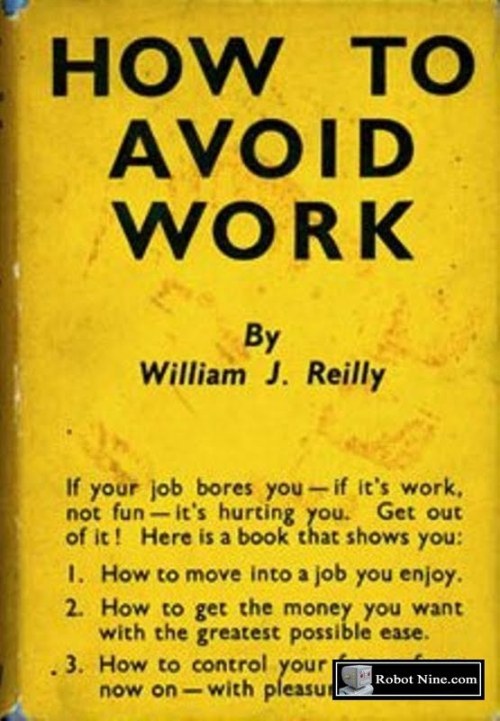
We discovered a 1949 book called How To Avoid Work when my girlfriend found a postcard reproduction of its dust cover for sale in the British Library gift shop. The book is out of print and usually costs a fortune but we were lucky enough to find a copy on Etsy for a tenner.
The book is terse, austere, and thanks to the passage of time, somewhat quaint. It’s basically a career guidance book with the central message that “work” can be avoided if we think carefully about the kind of job we really want. It’s a bit of a rip-off in that you’ll still have a career and a daily job if you follow this advice, but there’s wisdom in the notion that we don’t have to do work that contradicts our values or wastes our true talents.
Much of the book is too old-fashioned to still be applicable: there’s a funny chapter about ‘sponsorship’ – a method of landing a corporate job by means of informal schmoozing. There’s also an old-fashioned and hectoring lingo, and a strong assumption that the career-minded reader has external genitalia.
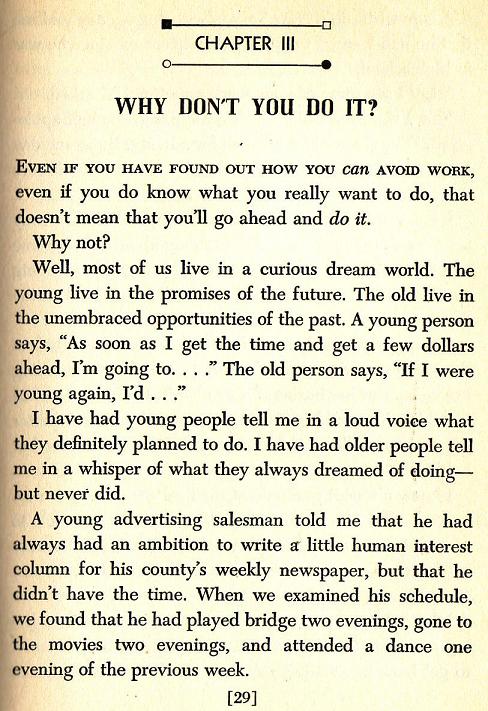
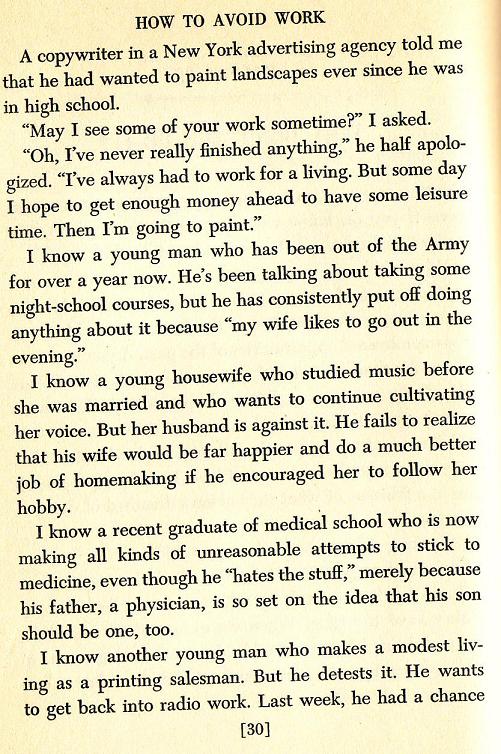
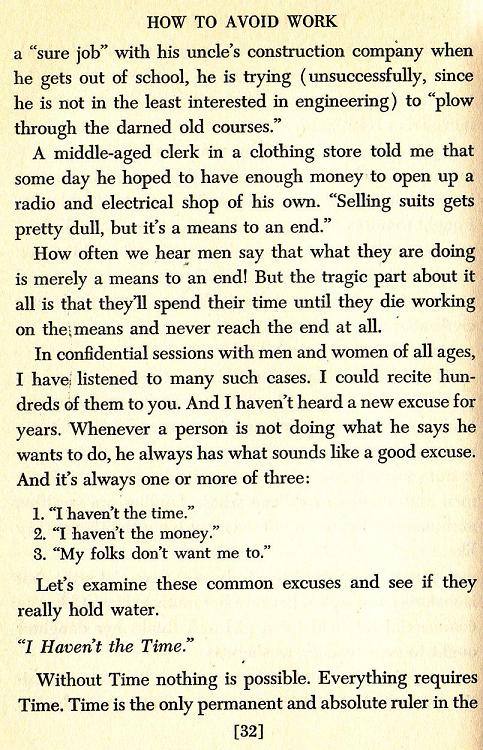
But there’s one interesting chapter called “Why don’t you do it?” which is ostensibly about New Escapologist‘s favourite subject: Bad Faith. It asks why so many people do things they don’t want to do (and fail to do the things they truly want to do). Here’s a little sample. You’ll probably agree that it still holds water.

Buy the complete back catalogue of New Escapologist with a 10% discount today.

About Robert Wringham
Robert Wringham is the editor of New Escapologist. He also writes books and articles. Read more at wringham.co.uk




I like … and can relate to lots .. and now I do have the time and the money 😉
The paragraph about the housewife not following her hobby is all to very real even today ….
Some old things can still make sense 🙂
Over this past winter I read Thoreau’s Walden. Similar to the book in this blog posting, Thoreau bangs on about people wasting time, pursing money in the hope it will create time to do what they aren’t and people generally not really doing what they want for a load of invented reasons. I was truly astounded at how this mid-19th centry book was so astute in its observations and how relevant they are to today. If you haven’t read it, go find a copy.
I love this. It challenges the nostalgic notion that everyone in the 1940’s-50’s looked at work and education differently than we do today. It is sad that so many people plod along through the muck when there’s a nice path we could be taking, instead, if only we have the small bit of courage to take it and see where it leads.
Walden is great. He was properly bonkers – a transcendentalist and everything – but his account of his time at the pond is smashing and some of the ideas in it did help inspire New Escapologist.
This is the thing. We’re discouraged from certain careers. In Britain, it’s often class-oriented. “No son o’ mine’s gonna be a hairdresser!” But sometimes it’s with the best intentions. One might think that becoming a musician will be a risky course of action compared to becoming a plumber – but if you commit your whole life doing something you have no love for then you’ve already lost.
Such a timeless post.
I wounder how I didn’t find it before today.
Actually I think that it’s our guilt that prevents us from doing what we like.
From a very young age, it seems our close family wants to make us safe, so they send us to the good schools, point us to the best careers. (all they are basically doing is projecting their insecurities upon us).
No matter if we suceed or not, we might dream of doing something different, or we wish to accomplish great things and make our relatives proud.
Among our obstacles are the following:
1- A generalization of Parkinson’s Law implying that “the demand upon a resource tends to expand to match the supply of the resource”. Either time or money, we waste what we have on many trivial projects while neglecting our masterpiece. (maybe we’re affraid to aim too high and fail, so instead we don’t even try)
2- So called “Protestant work ethics”, meaning that we first have to suffer through hard work in order to deserve leisure and peace of mind, paying our dues.
3- A perception that the higher ranks have it better than us, either from more challenging work to eliminate boredom, or a least more income to pay for luxuries and experiences.
How many times have we heard a really bright person say they will work some more in a job they hate because it’s the most rewarding financially? Of course, this will allow them plenty of ressources for their leisurely pursuits… (maybe because they are afraid, deep down inside, that they might not like that new found freedom)
Problem is, once we get on this threadmill, we get so used to reach for more means to our ambitions that we are affraid to change course once we have more than enough.
Just like the obese nerd who learnt everything about fitness while reading books for hours, but who never set a foot in a gym nor lifted a single weight, so all these resources didn’t even make his life better as he stubbornly refused to use them.
We think we are doing the hard and incomfortable… but once we become a workaholic (or busy procrastinator), working harder is actually the easiest way out.
How many of us will fill our days with boring tasks, in a poor attempt to free resources for then reaching our potential, to eventually die with our music still inside of us as we never dared to make the leap?