Issue Eleven — Out Now!

Here comes the slow stepper. New Escapologist Issue Eleven: Small is Beautiful.
Featuring Justin Reynolds on William Morris, Neil Scott on Russell Brand’s revolution; Tania O’Donnell on book excerpts, a new story by Ian Macpherson; Robert Wringham on E.F. Schumacher and a beautified reprint of Bob Black’s important 1985 essay The Abolition of Work. 96 pages. £6 / €7.80 / US$10 / C$10
Now available in the shop. Subscriber copies will be dispatched soon.
Shop Update

Making changes to our online shop is always an adventure. Such a fiddly and complicated business, after which I’m invariably moved to fix a stiff beverage.
Be that as it may, I’m proud to draw your attention to our new back issue packages. Gone is the old “complete back catalogue” offer (with eleven issues under our belt, it became a rather expensive product) and in its place are two new bundles: Issues 1-7 (£35) and Issues 8-11 (£22).
The same bundles are available in PDF for £33 and £20 respectively.
Far more affordable in every instance, I think you’ll agree. The bundles are also 10% cheaper than buying each issue individually.
The keen-eyed among you will have noticed my reference above to eleven issues rather than the factually extant ten. That’s because Issue Eleven: Small is Beautiful is almost ready to go, earmarked for release on December 17th 19th.
I chose to forego the usual pre-ordering process on Issue Eleven, so you can’t actually order it yet unless you cleverly buy the aforementioned 8-11 bundle. Why so? I’m already up to my eyeballs in expectational debt over the book (now 68% funded!). Instead, I’ll let you know as soon as Eleven’s available.
Seasons Greetings, everyone! Ho Ho Ho etc!
Letters to the Editor: The Weird One
Our print magazine doesn’t have a “letters to the editor” section. I long ago chose to shun the usual magazine ephemera (news, reviews, letters, ads) in favour of evergreen essays, opinions and stories.
I stand by this decision because it means our content can properly engage instead of distract, and also that our mags are still readable and relevant long after publication.
Still, I sometimes wonder if a “letters to the editor” section wouldn’t provide a sense of community around New Escapologist. It would confirm that there are other Escapologists out there: some successful, others struggling, but all with the shared and uncommon tendency to take escape seriously.
Well, luckily we have the blog. If you’d like to submit a Letter to the Editor, feel free to get in touch. Just let me know if you’re happy for it to appear on the blog.
Here’s our first LttE.

Good morning/afternoon Rob,
I’m extremely excited to dive into the back issues. I’ve been a follower of your blog for some time and have experienced a complete 180 in my mindset over the past 1-2 years in regards to escaping it all!
I am actually a Certified Public Accountant in the USA located in one of the wealthiest parts of the country. The way I was raised and the things I have noticed as I’ve matured have caused me to rethink my whole mentality and what it means to “Live the American Dream”.
Seeing countless “wealthy” individuals in my hometown driving the luxury automobiles and building the $1-million+ mansions, all the while being shackled to creditors and ultimately their desks, has forced me to rethink my direction in life and strive to focus on something more fulfilling than punching the time card, taking a paycheck and keeping up with the Joneses.
Thankfully, I have been able to share my new attitude with many of my friends and colleagues in the hopes of helping them to revamp their total fiscal mindset (and not the typical tax advice that a larger mortgage/interest helps for taxes).
However, as I’ve become more open about my thoughts, plans, new mindset, I’ve met with a strange reaction. I’m being perceived as the “weird” one! It has actually been completely entertaining to see people’s reactions and their defense of the current system.
Anyway, I’m sorry to ramble. My point is that I am excited to read more and would be very interested in helping you and/or contributing to your mission if there is a need. I am not looking for compensation, only for a way to express my thoughts and research and/or to help refine others’ similar thoughts/research.
Thank you again,
L
Dear L. Thank you for writing in. I like the quotation marks you put on “wealthy”, especially given your job as an accountant to the American rich. Since coming to Canada, I’ve met a lot of these “wealthy” suburban types and it’s hard to see how they’re anything of the sort. If they’re in debt to creditors, it doesn’t matter how big or well-appointed their house is. Surely purchasing power isn’t the same thing as wealth, even in the world of finance. It can’t be healthy. For my sins, I went to an event at the Ritz recently and rubbed shoulders with multi-millionaires. They’re all insane, incapable of intelligible conversation or even dressing themselves properly. I can only imagine they’ve been driven mad with anxiety over the vast sums of credit (Mirror Universe money) they’re handling.
★ Tired of the everyday grind? Pre-order the New Escapologist book today.
William Morris at Home and at Work

At Home:
If you want a golden rule that will fit everything, this is it: Have nothing in your houses that you do not know to be useful or believe to be beautiful.
At Work:
Nothing should be made by man’s labour which is not worth making, or which must be made by labour degrading to the makers.
★ Tired of the everyday grind? Pre-order the New Escapologist book today.
What’s the Point, If We Can’t Have Fun?
My friend June Thunderstorm and I once spent a half an hour sitting in a meadow by a mountain lake, watching an inchworm dangle from the top of a stalk of grass, twist about in every possible direction, and then leap to the next stalk and do the same thing. And so it proceeded, in a vast circle, with what must have been a vast expenditure of energy, for what seemed like absolutely no reason at all.
This is David Graeber on the “play principle at the basis of all physical reality”.
The idea is that everything we do in nature has a play ethic at the heart of it. Only under capitalism (or at least utilitarianism) has this become perverted by the economic imperative.
Remember Will Self’s advice:
Just breathe. Walk. Think. Meditate. I really, really urge you to get out and have a decent walk, preferably to a random destination, one that is not economically compelled. That’s all I really have to say to you.
Do something just for fun, if not everything.
★ Tired of the everyday grind? Pre-order the New Escapologist book today.
Return to Busytown
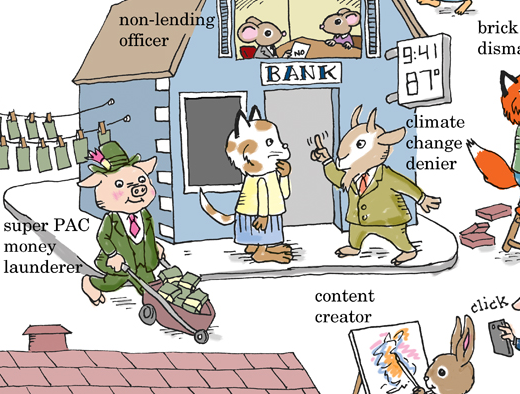
“If your job wasn’t performed by a cat or a boa constrictor in a Richard Scarry book, I’m not sure I believe it’s necessary,” said Tim Kreider in 2012, his point being that most modern jobs are as pointless as they are dull.
Well, Tom the Dancing Bug has responded by showing how a Richard Scarry book might look if Busytown had been populated by the kind of dot-eyed, uncreative twerps they’d like us to be.
Remember, this is not inevitable! You can do anything you fancy! Life is absurd! You are free!
★ Tired of the everyday grind? Pre-order the New Escapologist book today.
William Morris at the NPG
In an excellent piece about William Morris for our forthcoming eleventh issue, Justin Reynolds mentions a Morris exhibition currently at the National Portrait Gallery in London.
Alas, by the time the magazine is in your hands, the exhibition will be almost over. So I’m mentioning it now.
William Morris: Anarchy and Beauty will be at the National Portrait Gallery until 11th January 2015. Sounds like it might be worth a look if you’re nearby.
★ Tired of the everyday grind? Pre-order the New Escapologist book today.
Can Quitting Your Job Help Stop War?
I love it when treadmill types are bowled over by the idea that a modest income doesn’t necessarily mean a life of wretched poverty.
Think, people. Curb your insatiability. Take responsibility for how you spend and earn money. Develop a moral code. Above all, live well.
Here’s New Escapologist contributor David Gross profiled in the Atlantic:
When he first started his experiment, Gross assumed he’d have to live in poverty to avoid paying federal taxes. He thought about living in a fire spotting tower to pay the rent, and resigned himself to a life of rice and ramen, and “a path of deprivation, sacrifice, and renunciation in the service of my values”.
But then he started doing some research. He knew he wanted to set aside some money for retirement, and that he could probably find enough contract work to earn as little or as much as he wanted, up to the salary he had been receiving.
★ Tired of the everyday grind? Pre-order the New Escapologist book today.
Lockpicking Imaginary Handcuffs
 The fine fellows of the Mountain Shores (Un)Productivity Podcast had me on as a guest.
I was there ostensibly to promote Escape Everything! but we had far more fun than that. We talked about Houdini, humor writing, self-help, daily routines, Tim Ferriss, Jon Ronson, Russell Brand, Jane Austin, Henry Miller, David Graeber and many others. Ears must have been burning all over. Not that yours will when you listen, of course. Tune in. It’s a great podcast.
★ Tired of the everyday grind? Pre-order the New Escapologist book today.
Two articles on Quitting
There must be something in the air. Two mainstream press articles about quitting boring jobs.
From the Atlantic:
My friends sometimes approach me with career anxieties, under the false impression that writing about economics makes somebody a good career advisor. My counsel is typically something like optimistic incrementalism. Don’t quit your job, mastery comes with time, job satisfaction comes with mastery… that sort of stuff. […] I never said it outright, but I assumed that my cautious approach was more responsible […] but according to a new study of youth unemployment […] my incrementalist advice, while appropriate for the worst periods of the Great Recession, isn’t so great, overall.
From the BBC:
many of us aren’t happy in our jobs. Only 53% of US workers surveyed by online job-search website Monster.com, said they liked or loved their jobs, while in France that dropped to 43% and in Germany, to 34%. With discontent that high, at what point does it make sense to leave a boring job and find one that not only pays you well and gives you perks, but also makes you happy?
★ Tired of the everyday grind? Pre-order the New Escapologist book today.