The Tabloid Incident
I was struck today by the strangeness of the word “tabloid”. I was reading an essay on the Web and I think I may have been expecting the word “tablet”.
“Tabloid” struck me as more futuristic-sounding than “tablet” and for a tiny moment I wondered what a tabloid might actually be. Some kind of new interface? A clever bit of portable tech? Astronaut food in pill-form?
Of course not. It’s a tabloid. An ink-and-paper publication, usually about celebrities and fashion and UFOs. My weird outsider life means I haven’t seen a tabloid newspaper for years and I’d sort of forgotten about them.
It was exactly like how I once struggled to convince myself that coca-cola was a real thing.
I think I’m properly beginning to identify with the protagonist of that novel, À rebours.
Buy the all-new Issue Nine in print or on PDF here.
Buy the complete back catalogue of New Escapologist with a 10% discount here.
Buy the complete back catalogue on PDF, with £1 off the price of each issue here.
Blurb 9
This is what the blurb looks like on the back cover of Issue Nine.

Buy the all-new Issue Nine in print or on PDF here.
Buy the complete back catalogue of New Escapologist with a 10% discount here.
Buy the complete back catalogue on PDF, with £1 off the price of each issue here.
Professionalism
What, precisely, is professionalism?
In the rather good movie Berberian Sound Studio, an unpleasant film director defines it for us:
Gilderoy, let me just tell you what it is to be a professional. It’s very simple. You cooperate, you don’t question. You don’t argue. You don’t look at your watch. You just do the work you’re told to do and keep your personal opinion where it belongs. Am I clear?
Very!
Buy the all-new Issue Nine in print or on PDF here.
Buy the complete back catalogue of New Escapologist with a 10% discount here.
Buy the complete back catalogue on PDF, with £1 off the price of each issue here.
Issue Nine
Finally! Issue 9 of New Escapologist is ready to go. The theme is money. The title is “Take the Money and Run”. This is what the cover looks like.
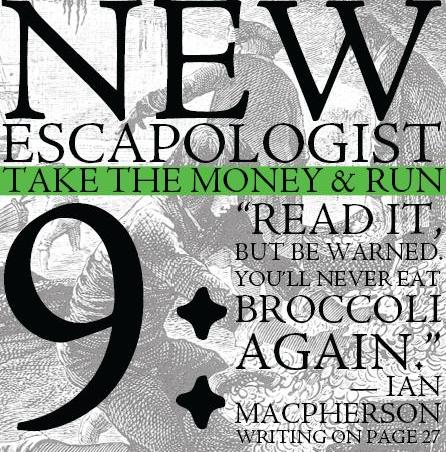
Highlights of the issue include a short piece by Dice Man Luke Rhinehart; an interview with philosopher Joseph Heath; a short story by comedian Ian Macpherson; top-drawer humour from Robert Wringham; and articles by blog giants Jacob Lund Fisker and Mr. Money Mustache.
To whet your appetite, here’s the table of contents:
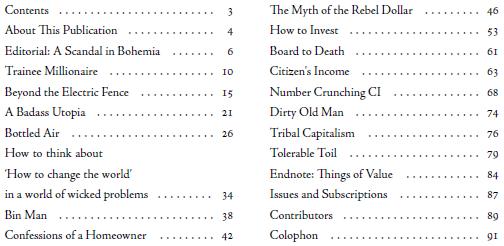
It’s a massive 92 pages of nicely-typeset money-themed Escapological marvels.
Buy it now! Available in print and PDF.
Subscriber copies and pre-orders are already flying the nest.
Buy the complete back catalogue of New Escapologist with a 10% discount.
Or buy the complete back catalogue on PDF, with £1 off the price of each issue.
One More Freeman
I’ll be making much less for a little while, but I don’t mind that at all, because I become immediately freed from paying the dozens of insidious costs of a steady corporate paycheck — the anti-creative cubicular environment, the dark and fearful mood that descends every Sunday evening, the treadmill of forgettable tasks that have nothing to do with my values, and the attitude of total subordination that’s required to stay employed, to name only a few.
And although they’re not strictly forbidden by living as a fifty-hour-a-week employee, certain pursuits had become a lot more difficult. Since I’m already using my evenings and weekends to run a blog, maintain a few friendships, and keep my home and clothing clean, “electives” like exercising, reading, and conducting creative experiments never find a consistent space to flourish as habits.
Congratulations are due to friend David of Raptitude who escapes the everyday grind on October 11th.
Operation Save-and-Quit
You’re right to think seriously of quitting. You badly need a complete break, with time to think. And that won’t be possible immediately.
I was delighted to see the Guardian careers advisor (and his readers) encouraging someone to take the money and run.
You have £100,000 savings. Either quit outright now, or ask your boss if there’s a possibility of a six-month sabbatical if you feel that all you need is time off rather than a change of lifestyle. The technical sector is still doing well: if you have the experience and drive you say you have, you’ll have no problems finding another job once you’ve taken a break.
Pre-order Issue Nine in print or on PDF today.
Buy the complete back catalogue of New Escapologist with a 10% discount.
Or buy the complete back catalogue on PDF, with £1 off the price of each issue.
Happy 20th Birthday, The Idler!

Where do you get your ideas from? If you’re working all day, it kind of kills a lot. So daydreaming is a productive activity. It’s also about visualising your ideal world, both the kind of world you live in and also who you want to hang around with and what you want to spend your time doing. My ideal world, which I’ve been thinking about for 10 years, is the film world, where I can make films and watch movies and be around creative people.
When I was 17, I remember thinking, ‘My whole life is anticipation, everything I’m doing in school is to serve some future purpose.’ All people would say is, ‘What are you going to do when you grow up?’ Wait – you mean we’re not people right now? You’re being moulded to be a little drone-worker in the system.
Thus spake Dazed and Confused filmmaker Richard Linklater, interviewed by a young Idler in 1994.
The Idler has come of age and, to celebrate, they’re releasing a collection of fifty interviews with fabulous bohemians and idle thinkers from the magazine’s capacious archive. You can order a copy here.
There’s also a smashing sample from the volume in the Independent today.
The Idler was, of course, a major part of the inspiration for New Escapologist. Their editor, Tom, also gave us some good breaks by recommending us to his readership, by allowing me write for his magazine, and doing an event with us in Glasgow. Since it began in 1993, the Idler has evolved into a high-quality annual of joyful, counter-cultural essays and an entire enterprise in the form of the Idler Academy. Long may they flourish! But effortlessly.
Pre-order Issue Nine in print or on PDF today.
Buy the complete back catalogue of New Escapologist with a 10% discount.
Or buy the complete back catalogue on PDF, with £1 off the price of each issue.
The Carbonated Beverage Blues
I’m sometimes reminded that carbonated beverages exist. Coke. Sprite. 7Up. Nozz-a-la? Is that one? (Yes).
The last time I thought about carbonated beverages, I struggled to convince myself that coke actually exists.
I once put together a bookfair in a student-occupied university building. Preparing for the event, I moved the makeshift bed of one of the squatters and twenty plastic coca-cola bottles rolled out into the room.
Why would an Anarchist drink coca-cola? That’s about as close as you can get to drinking Capitalism. You are drinking your enemy! That is what your enemy tastes like, and now it’s in your stomach!
Carbonated beverages are addictive, expensive, disastrous for your health, and bad for the environment. If you buy it, Anarchists, you are directly funding one of the biggest and most totemic-of-capitalism companies on the planet.
Step 1 of being an Anarchist should be: withdraw your funding. You can start by not drinking coke.
Step 1 of being an Escapologist is probably: stop wasting your money and eroding your health. You can start by not drinking coke.
If you do nothing else good with your life, stop drinking coke.
It amazes me that anyone drinks coke. You know grown-up drinks like beer and wine exist, don’t you? And tea? And tap water? Bloody hell. Coke.
Pre-order Issue Nine in print or on PDF today.
Buy the complete back catalogue of New Escapologist with a 10% discount.
Or buy the complete back catalogue on PDF, with £1 off the price of each issue.
Join our mailing list
The newsletter is back! To enjoy this miraculous revival, plop your email address in the form below.
You can view a sample of the newsletter here.
Vergaderziekte
Something we’ve often overlooked in New Escapologist is that people might actually like their jobs, or rather the core duties of them.
What often gets people down is the culture of work: above all, the inefficient expectation that we commit no less than 35 hours per week to a job that could be done in 10; and to maintain an atmosphere of manic busyness throughout or face accusations of laziness.
Schumpeter in praise of laziness in The Economist:
office workers are on a treadmill of pointless activity. Managers allow meetings to drag on for hours. Workers generate e-mails because it requires little effort and no thought. An entire management industry exists to spin the treadmill ever faster.
and:
[A survey last year] found that more than 80% of respondents continue to work after leaving the office, 69% cannot go to bed without checking their inbox and 38% routinely check their work e-mails at the dinner table. This activity is making it harder to focus on real work as opposed to make-work.
Pre-order Issue Nine in print or on PDF today.
Buy the complete back catalogue of New Escapologist with a 10% discount.
Or buy the complete back catalogue on PDF, with £1 off the price of each issue.