Never forget
Never forget the things from which you’re escaping.
I walked past an office building in downtown Montreal this evening. I was on my way to meet my girlfriend for a family meal, which we would follow by attending a magazine launch party. Inside the office, meanwhile, the desk jockeys were working overtime beneath florescent lighting.
No more of that for me, thanks. I felt immediately grateful for the fact I was on the outside of the stone wall and not on the inside any more.
Some things I do not miss:
– Clock watching
– Commuting
– Unsuitable working environment
– Pointlessly frequent fire drills and other health-and-safety obstacles
– Being unable to enter a productive (or leisurely) mood when recovering from a day’s work
– Mindless submission to tasks that do not matter
– Representing an organisation in which you have no interest
– Being an apologist for other people’s bad decisions
– Petty office politics
– Counterproductive cross-business politics
– Staring into a computer screen for 80% of the time
– Pointless meetings
– Frequent and demeaning training exercises
– The dreaded early rises
These are just a few of things I do not miss. I’m sure there are others.
Even when I worked though, I found ways around a lot of these things:
– I’d find ways to work from home whenever possible
– I’d volunteer to attend conferences so I didn’t have to sit at my desk all of the time
– I’d wear an immaculate suit almost as if to satirise office etiquette
– I took an hour-long lunch break every day instead of eating at my desk
– I moved my home to within a ten-minute walk of the office so I didn’t have to commute so far or rise so early
Interestingly, few of my colleagues took these measures even when I was providing a precedent. They seemed more content to complain about the conditions that were being imposed upon them without realising that even within the framework of their office life there were small freedoms to be found. Why did they not take them? Did they prefer to complain? Were they the victims of peer pressure or Bad Faith?
On Living Well
Spending 40 years of my life working just to buy stuff seems a bit extreme to me. Yet working that much is the norm in the US. It is so ubiquitous that spending all day away from home does not factor into people’s “comfort calculations”—only leather seats and oversized furniture do. However, living is about what you do, not what you have.
Jacob Lund Fisker runs a truly amazing website called Early Retirement Extreme. The site disseminates ideas around the maxim that life is too short to squander on mindless drudgery. Instead he recommends sage financial prudence: frugality, asceticism and sensible investment.
Any one of Jacob’s posts is worth a read and I’d encourage anyone to buy his upcoming book as soon as it’s available. To get you started, I’d point you at this recent post or this concise manifesto. You’ll soon be hooked. In fact, I’m reading the whole website from the first post.
It’s entirely possible to eliminate the need for pointless graft.
An Escapologist’s Diary. Part 11.
 Last weekend, we attended the Montreal Anarchist Bookfair, taking along a stall from which to sell copies of our little publication.
Anarchists of different stripes had come from far and wide, and plenty of likeminded and interested members of the public came along to see what we were up to. I don’t think I’ve seen an Anarchist event so well organised and well attended. Inspiring all round.
I have to hand it to the non-Anarchist members of the public for showing up in such impressive numbers. When I mention Anarchy to new friends, I’m often met with bemusement: either such a bold political stance seems out of place on such a mild-mannered individual as myself or the very concept of Anarchy in the modern day seems absurd to the average person. Yet here we were.
The fact that so many non-Anarchists attended the event meant that we (and presumably the other stall-holders and presenters) weren’t preaching exclusively to the choir. I spoke to plenty of people with conventional jobs who were beginning to consider various escape routes.
The New Escapologist stall sat between an American electro/punk band called Realicide and a semi-ironic Québécoise organisation called Front d’action stupide. I’m very glad I sat with the people I did because they were excellent company for the duration of the weekend, trading horror movie and music recommendations and discussing the nomadic lifestyle.
As the first morning progressed and I spoke to more and more people, I began to develop a sort of sales pitch for the magazine. I found myself describing the magazine as “a humour periodical from England” (at once explaining my accent to the largely Canadian audience and slightly adjusting their expectation that we’re a hardened political organisation) but that we offer “sincere advice and discourse on the art of living and how to escape the mindless drudgery of conventional career life”. I told them that we’re “pro-laziness and anti-work and we ask people to consider working less in favour of a low-impact, post-consumerist lifestyle”.
Whenever I used the expression “mindless drudgery” in my pitch, the Mohican-topped Robert Inhuman would chime in from the next stall with “As opposed to mindful drudgery!” knowing very well how much hard work has to go into producing zines and making money from indie exploits.
“Mindful drudgery” reminds me of my friend Tim who inverted the popular “Spiritual but not religious” maxim to “Religious but not spiritual”, admitting that he enjoys ritual and adhering to a strict code of ethics but refuses to believe in a spirit or to give himself over to a poorly-defined cause.
I’m glad I managed to explain the magazine so concisely: partly for the practical reason that I’d only have around two minutes with any potential reader, but also because I worry about Einstein’s words of wisdom: “If you can’t explain it simply, you don’t understand it well enough”. Did I definitely understand the nature of our harebrained scheme? It was now evident that I did.
We had been asked to work out of the zine room as opposed to the main books hall, which was fine, but I worried that our high cover price (by comparison to typical zines) would result in a lack of interest. I reduced our price as much as reasonably possible and told people that “we’re dedicated to making things of quality and have a pretty unique style of typography.” This technique proved fruitful and we managed to sell almost our entire stock over the course of the weekend.
On the second day, I was joined by Samara, our illustrations editor and frequent contributor, who had fun doodling personalised sketches on the reverse side of her business cards for people to take away. We also gave away sample content from Issue Three in the form of a new pamphlet designed by our usual typesetter, Tim.
People were invited to write their email addresses on a specially designated part of our tablecloth so that they could join our mailing list. In fact, they could write whatever notes or recommendations they liked on the same tablecloth. It was funny how many people commented on this idea but as a minimalist it seemed natural to me: I didn’t want to keep the tablecloth after the event and I didn’t want to have a bundle of note papers to cart sift through later. The contents of the tablecloth are now safely typed up into my computer.
I didn’t take any photographs beyond one of our own stall because I met a rough reception from a staunch off-gridder when photographing the crowded main hall, but I see that a few have made it onto Flickr.
Thanks to everyone at the bookfair for putting together such an impressive event. Whenever I organise a comedy show or an Escapology event, people always seem amazed that someone acheived something beyond the norm, yet these are always far smaller affairs than this one. Kudos to all.
I’d love to do another event like this soon. The next one I can identify as having a similar flavour is Expozine, for which I will be sure to register but doesn’t happen until November. If anyone has recommendations of similar events (anywhere in the world), we’d love to hear about them.
Rich Dad
It’s not exactly a sparkling new resource, but richdad.com (companion website to the brilliant book, Rich Dad, Poor Dad) contains some great ways of looking at money and economics.
The site demonstrates differences in how the conventional middle class (or ‘Poor Dad’) have evolved to think about money and how successful business types (‘Rich Dad’) think about it. It’s a matter of looking at the same thing from a different perspective. You just have to throw out a few conventional habits in favour of some smarter ones.
For example, the middle class ethic is to work for money, while the wise ‘Rich Dads’ knows how to make money work for them. Poor Dad sees his property as assets while Rich Dad sees them as liabilities. “Understanding the difference in attitudes,” the site says, “is essential to taking the first steps to financial freedom.”
An Escapologist’s Diary. Part 10.
Life is good here in Montreal. I spend most of my time leisurely cooking in our little kitchen or reading George Orwell books in the sunny park. (We should hit 30°C this week!)
You don’t need much money for either of these activities: just a few quid for dinner ingredients and the occasional bus fare to the library. The good life is there if you want it. You just have to stop buying pointless stuff and quit your job as soon as you can.
Much like the protagonist in Orwell’s Keep the Aspidistra Flying, however, I’ve not been able to stop my mind from drifting periodically into the vulgar world of money.
The preoccupation is partly due to an idle interest in economics but also—less comfortably—an abstract and groundless fear that a life without significant income is somehow sinful or unsustainable and that my good life here and now is tantamount to hubris. I know my fears are the result of growing up in an environment in which the Protestant Work Ethic reigned over all of us; and I know very well that I can live here for a long time without sucking up to the money god. Yet there is a nagging homunculus on my shoulder insisting that I should be doing something more lucrative.
I usually deal with this by playing Louis Armstrong’s version of, “Lazybones” loud enough to drown out the homunculus’ ridiculous witterings:
Hey there lazybones, lyin’ in the sun, how you gonna get your day’s work done?
What day’s work, man? I’m too busy baskin’ in the noonday sun.
Read the rest of this entry »
Bookfair appearance
We’ll be running a stall at the Montreal Anarchist Bookfair in Canada, at which we’ll hopefully be selling magazines and badges and generally spreading our Escapological whimsy. We’ll surely also blog about the event here as it unfolds. Any help or provision is welcome.

MONTREAL ANARCHIST BOOKFAIR 2010
MAY 29-30, 10am-5pm
at the CEDA, 2515 rue Delisle
(a short walk from Lionel-Groulx metro)
FREE. Welcome to all!
Special Offer on Issue Three
We have a strictly-limited 20 copies of Issue Three available for the special price of £4 (usual price £6). The International shipping fees are also slightly reduced.
Issue Three is our finest issue to date, containing valuable practical nuggets from all manner of successful and aspiring Escapologists. Own a copy already? Why not buy one for a fellow Escapologist or inmate?
Issue Four in the pipeline
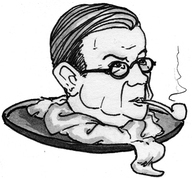 Rejoice! Work has officially begun on the fourth issue of New Escapologist, due for release in early August. This issue’s main topic is Mauvaise Foi: a concept discussed by Existentialist philosopher, Jean-Paul Sartre whose rather handsome severed head is pictured to the left.
As a point of interest, Sartre also wrote the play, No Exit, which was one of the early title suggestions for our very own magazine (along with Ejector Seat and Scarpering Quarterly and other things too terrible with hindsight to contemplate).
Issue Four is now available to pre-order for £5. The cover price is likely to be £6 so take advantage of this early-bird price.
Freelance writers, illustrators and laypeople with ideas are welcome to send work, pitches or suggestions. Just check our brief contributor guidelines first.
The Practicalities Issue will be a hard act to follow but I think Issue Four will be something special nonetheless.
Illustration by Samara Leibner.
More words on needing less
One of the most important things to an Escapologist is mobility. Each possession or dependency compromises mobility, so why not hone a minimalist lifestyle? Here’s Leo Babauta on ‘needing less’:
It’s amazing what our culture has done to us: we have been conditioned to believe that luxuries are a necessity, that we need things that most of the world doesn’t even dream of having.
FAO: your lapel
There’s a beautiful set of New Escapologist badges available from our Glaswegian friends at Big Wow Badges. They come individually at a cost of 60p or as a glorious set of four.
Available are the the definitive ‘escaping man’ symbol; the Fluchtverdächtiger (escape suspect) badge from the Nazi concentration camps; the cool blue symbol of infinity or Absurdity; and Samara Leibner’s handsome turtle illustration.