Rich Dad
It’s not exactly a sparkling new resource, but richdad.com (companion website to the brilliant book, Rich Dad, Poor Dad) contains some great ways of looking at money and economics.
The site demonstrates differences in how the conventional middle class (or ‘Poor Dad’) have evolved to think about money and how successful business types (‘Rich Dad’) think about it. It’s a matter of looking at the same thing from a different perspective. You just have to throw out a few conventional habits in favour of some smarter ones.
For example, the middle class ethic is to work for money, while the wise ‘Rich Dads’ knows how to make money work for them. Poor Dad sees his property as assets while Rich Dad sees them as liabilities. “Understanding the difference in attitudes,” the site says, “is essential to taking the first steps to financial freedom.”
An Escapologist’s Diary. Part 10.
Life is good here in Montreal. I spend most of my time leisurely cooking in our little kitchen or reading George Orwell books in the sunny park. (We should hit 30°C this week!)
You don’t need much money for either of these activities: just a few quid for dinner ingredients and the occasional bus fare to the library. The good life is there if you want it. You just have to stop buying pointless stuff and quit your job as soon as you can.
Much like the protagonist in Orwell’s Keep the Aspidistra Flying, however, I’ve not been able to stop my mind from drifting periodically into the vulgar world of money.
The preoccupation is partly due to an idle interest in economics but also—less comfortably—an abstract and groundless fear that a life without significant income is somehow sinful or unsustainable and that my good life here and now is tantamount to hubris. I know my fears are the result of growing up in an environment in which the Protestant Work Ethic reigned over all of us; and I know very well that I can live here for a long time without sucking up to the money god. Yet there is a nagging homunculus on my shoulder insisting that I should be doing something more lucrative.
I usually deal with this by playing Louis Armstrong’s version of, “Lazybones” loud enough to drown out the homunculus’ ridiculous witterings:
Hey there lazybones, lyin’ in the sun, how you gonna get your day’s work done?
What day’s work, man? I’m too busy baskin’ in the noonday sun.
Read the rest of this entry »
Bookfair appearance
We’ll be running a stall at the Montreal Anarchist Bookfair in Canada, at which we’ll hopefully be selling magazines and badges and generally spreading our Escapological whimsy. We’ll surely also blog about the event here as it unfolds. Any help or provision is welcome.

MONTREAL ANARCHIST BOOKFAIR 2010
MAY 29-30, 10am-5pm
at the CEDA, 2515 rue Delisle
(a short walk from Lionel-Groulx metro)
FREE. Welcome to all!
Special Offer on Issue Three
We have a strictly-limited 20 copies of Issue Three available for the special price of £4 (usual price £6). The International shipping fees are also slightly reduced.
Issue Three is our finest issue to date, containing valuable practical nuggets from all manner of successful and aspiring Escapologists. Own a copy already? Why not buy one for a fellow Escapologist or inmate?
Issue Four in the pipeline
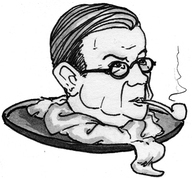 Rejoice! Work has officially begun on the fourth issue of New Escapologist, due for release in early August. This issue’s main topic is Mauvaise Foi: a concept discussed by Existentialist philosopher, Jean-Paul Sartre whose rather handsome severed head is pictured to the left.
As a point of interest, Sartre also wrote the play, No Exit, which was one of the early title suggestions for our very own magazine (along with Ejector Seat and Scarpering Quarterly and other things too terrible with hindsight to contemplate).
Issue Four is now available to pre-order for £5. The cover price is likely to be £6 so take advantage of this early-bird price.
Freelance writers, illustrators and laypeople with ideas are welcome to send work, pitches or suggestions. Just check our brief contributor guidelines first.
The Practicalities Issue will be a hard act to follow but I think Issue Four will be something special nonetheless.
Illustration by Samara Leibner.
More words on needing less
One of the most important things to an Escapologist is mobility. Each possession or dependency compromises mobility, so why not hone a minimalist lifestyle? Here’s Leo Babauta on ‘needing less’:
It’s amazing what our culture has done to us: we have been conditioned to believe that luxuries are a necessity, that we need things that most of the world doesn’t even dream of having.
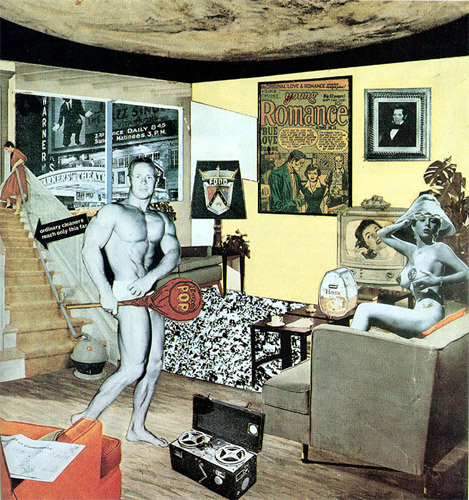
FAO: your lapel
There’s a beautiful set of New Escapologist badges available from our Glaswegian friends at Big Wow Badges. They come individually at a cost of 60p or as a glorious set of four.
Available are the the definitive ‘escaping man’ symbol; the Fluchtverdächtiger (escape suspect) badge from the Nazi concentration camps; the cool blue symbol of infinity or Absurdity; and Samara Leibner’s handsome turtle illustration.

The shortest route to freedom
“The shortest route to the good life involves building the confidence that you can live happily within your means (whatever the means provided by the choices that are truly acceptable to you turn out to be). It’s scary to imagine living on less. But embracing your dreams is surprisingly liberating. Instilled with a sense of purpose, your spending habits naturally reorganize, because you discover that you need less. This is an extremely threatening conclusion. It suggests that the vast majority of us aren’t just putting our dreams on ice – we’re killing them.”
I chanced across this 2002 article by Po Bronson, ostensibly an overview of his book What should I do with my life? (a book that profiles the careers of fifty interesting people and extrapolates prescriptions on how to tap inner callings). The article contains some insightful passages and is worth a read.
There are further sample chapters at the author’s tie-in webpage.
One thing I notice from Mr. Bronson’s profiles, is that most people who make breakthroughs about how they want to spend their life, start with a fallow period during which they contemplate the big question. One person spends six months in bed after a car accident, planning the changes he’d like to make once he’s back in the game. Another person deliberately quits her high-pressure job to spend three years mulling over the prospects of what she really wanted to do all along.
To me, this helps to confirm that the escape from depressing commitments is the first step toward committing yourself to something useful and that you’ll act deliberately when you’re good and ready. If dissatisfied, take the plunge and escape. You’ll soon find yourself making plans.
The Machine Stops
If we ever launch an anthology of classic literature with an Escapological flavour (which we might!), E. M. Forster’s short story, ‘The Machine Stops’ would be at the forefront.
The story describes a future society in which—natural resources having been squandered—the citizens live inside a gigantic life-giving machine. In the tradition of such tales, a man grows tired of this simulated life and seeks escape.
You can read the story online or enjoy a public domain audiobook version. There’s even a faithful 1960s television adaptation:
Thanks to Tim for the recommendation.
Cave dwellings, a Lego house and UFO ranches
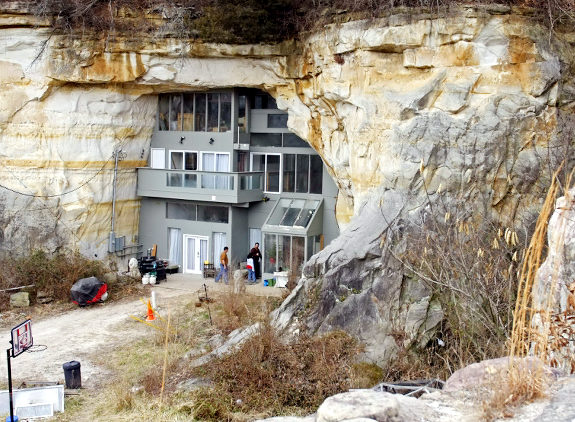
They’re probably (though not necessarily) outside the budget of most Escapologists, but this shortlist of interesting homes certainly inspires one to think creatively about living solutions.