Taboo?
There’s no two ways about it. The world needs New Escapologist.
A Manhattan court typist, it’s been found, spent 30 trials typing the words “I hate my job” over and over again.
Many feel it’s a disgrace that someone so unhinged by boredom could have jeopardized the process of justice, but it’s also quite funny.
It’s especially funny for for people who, like the typist, hate their unfulfilling, deskilled jobs.
In the Guardian today, Dawn Foster asks why it’s so taboo for people to admit to feeling this way:
For some bizarre reason, it’s still taboo to admit that most jobs are unspeakably dull. On application forms, it’s anathema to write: “Reason for leaving last job: hated it”, and “Reason for applying for this post: I like money.” The fact that so many people gleefully shared this story shows that many of us, deep down, harbour a suspicion that our jobs aren’t necessarily what we want to be doing for the rest of our lives.
Buy the new Issue Ten in print or PDF today.
Buy the complete back catalogue of New Escapologist with a 10% discount.
Or buy the complete back catalogue on PDF, with £1 off the price each issue.
A Death Films Production
Thanks to Lentus for directing us to this short film by animator Steve Cuts.
Buy the new Issue Ten in print or PDF today.
Buy the complete back catalogue of New Escapologist with a 10% discount.
Or buy the complete back catalogue on PDF, with £1 off the price each issue.
Blurbology
Issue Ten of New Escapologist is almost ready to fly the nest.
For subscribers and those who have pre-ordered print or PDF copies, it’ll be on your doormats or in your inboxes in just a few days. Here’s a look at the issue’s blurb:
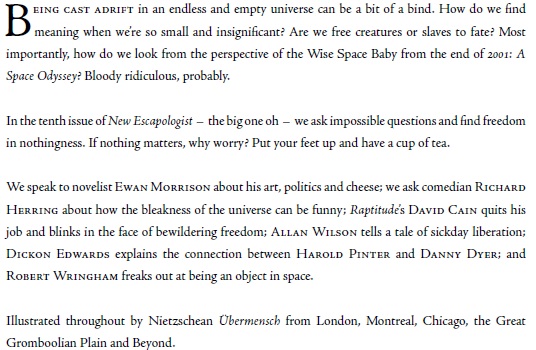
Buy the new Issue Nine in print or on PDF today.
Buy the complete back catalogue of New Escapologist with a 10% discount.
Or buy the complete back catalogue on PDF, with £1 off the price each issue.
Gerald Durrell

I’ve been reading a lot of Gerald Durrell lately. His short story, The Talking Head, was one of the most entertaining things I’ve ever read. Not an improving text, just a deeply delightful bit of memoir.
Durrell was a naturalist first and foremost, and wrote about his various expeditions to rescue endangered species around the world, but he’s equally well-known for books like My Family and Other Animals in which he relates adventures had with his family while growing up on Corfu.
In the introduction to his third volume of such stories, he anticipates the reader’s surprise that there could possibly be any more to tell, and explains his wealth of experience thusly:
…we were in those days, and certainly by Greek standards, comparatively wealthy; none of us worked in the accepted sense of the word and therefore most of our time was spent having fun. If you have five years of doing this, you accumulate quite a lot of experiences.
Rather than being an end in itself, their wealth allowed them to do away with time-wasting work and granted them the freedom to fill their time with pleasing activity.
As a family they spent most of their time on Corfu going on long walks, entertaining guests and throwing parties. Gerry’s brother Larry used his time to become a highly celebrated novelist. His other brother Leslie mainly spent his time studying ballistics for fun. Both are perfectly decent ways to spend a life.
Gerry himself spent his childhood exploring the island, hob-nobbing with peasants and aristocracy, collecting a bewildering range of animals (owls, spiders, puppies, fish, snails, turtles) for his home menagerie, and being tutored by eccentric local autodidacts. Sounds like an education to me.
In later life, Gerry became a professional naturalist and helped change the focus of zoos from spectacle to conservation. His legacy (in addition to his astonishing output of 42 books) is the Durrell Wildlife Park on the island of Jersey.
Buy the new Issue Nine in print or on PDF today.
Buy the complete back catalogue of New Escapologist with a 10% discount.
Or buy the complete back catalogue on PDF, with £1 off the price each issue.
NE10 Contents
Issue Ten of New Escapologist is almost ready to fly the nest.
For subscribers and those who have pre-ordered print or PDF copies, it’ll be on your doormats or in your inboxes in just a few days. Here’s a sneak preview of the Table of Contents.

This bumper tenth issue is dedicated to ABSURDITY. Featuring interviews with novelist Ewan Morrison and comedian Richard Herring; Raptitude’s David Cain on his new-found, post-job liberty; Robert Wringham on the walking through the wrong door; a short story of sick-day freedom by Allan Wilson; and Samara Leibner on why she hates drawers. Pre-order today. 104 pages.
Buy the new Issue Nine in print or on PDF today.
Buy the complete back catalogue of New Escapologist with a 10% discount.
Or buy the complete back catalogue on PDF, with £1 off the price each issue.
Borrowing Shop
Reggie draws our attention to a “borrowing shop” in Berlin.
The idea is simple. The shop has a stock of useful things like tools. Customers borrow the items as if the shop were a lending library instead of buying them for keeps.
It’s a way for a community to pool resources and for individuals not to suffer the burden of ownership.
If it were common to see this in neighbourhoods and the idea of borrowing, say, a lawnmower or a drill were a dependable one, it would be a real boon for minimalism and community spirit.
Just as you don’t need to own Harry Potter and the Deathly Hallows because it’s definitely in your local public library, you wouldn’t need to own a drill if you knew there was one to be borrowed from the borrowing shop.
I made the mistake of reading some of the comments thread in the article about the Berlin borrowing shop and it was filled with variations of the obvious criticism: how does it make money?
Generously overlooking the fact that “making money” shouldn’t be the aim of every last goddam thing (especially a community initiative for the benefit of everyone), the answer would be to charge a nominal fee per lend.
I don’t know why that would be a problem. Charge £2 per lend, perhaps with exceptions for the superpoor. Obviously. Everyone’s a winner.
It’s a great step back toward common public resources (payphone, town clock, public baths) instead of the private ones we’re all supposed to love under Neoliberalism.
Buy the new Issue Nine in print or on PDF today.
Buy the complete back catalogue of New Escapologist with a 10% discount.
Or buy the complete back catalogue on PDF, with £1 off the price each issue.
The ‘W’ Word
The definition of ‘Escapologist’ at Urban Dictionary, with reference to us goes:
Escapologist. Noun. (pronounced: es’cap·ol’o·gist). One who actively seeks to escape the imaginary manacles of modern life: work, debt, government, leisure industries, status and anxiety.
But, for marketing purposes, I’d prefer something punchier. How about:
Escapologists: we don’t do the ‘w’ word.
By which I mean ‘Work’. Obviously.
Most of us are pretty enthusiastic about walking, of course.
And a few of us are WWOOFERs.
And I know of a certain ‘w’ word which is the all-time number-one activity among the self-employed.
And some of us are wannabe writers.
And I once got an email from a reader who whittles.
But apart from those ‘w’ words, we don’t do the ‘w’ word.
Am I waffling?
Escapologists: we do lots of things that could be described as the ‘w’ word, but not very much of one particular ‘w’ word, that word being ‘work’. We try to avoid that.
Punchy.
Buy the new Issue Nine in print or on PDF today.
Buy the complete back catalogue of New Escapologist with a 10% discount.
Or buy the complete back catalogue on PDF, with £1 off the price each issue.
Thirty
A nice reflection by Erika L Sánchez about the status anxieties of turning 30, especially when comparing your successes to those of previous generations of 30-year-olds:
When I get my student loan bills, I ask myself many questions: should I get a regular job like a real grownup and just write on the side? When will I be able to afford to have children? Will this happen before my eggs go off? How long can I go on living on the cusp of financial ruin?
Buy the new Issue Nine in print or on PDF today.
Buy the complete back catalogue of New Escapologist with a 10% discount.
Or buy the complete back catalogue on PDF, with £1 off the price each issue.
Despair
Work-related one-liner from comedian Rob Delaney:
Sometimes I put a dog poop in the toilet at work so the guys don’t think I only went in there to cry.
Pre-order the forthcoming Issue Ten in print or on PDF today.
Running Ragged
From The Ragged-Trousered Philanthropists (1914):
As Owen thought of his child’s future, there sprang up within him a feeling of hatred and fury against his fellow workmen. They were the enemy–those ragged-trousered philanthropists, who not only quietly submitted like so many cattle to their miserable slavery for the benefit of others, but defended it and opposed and ridiculed any suggestion of reform. They were the real oppressors– the men who spoke of themselves as ‘the likes of us’ who, having lived in poverty all their lives, considered that what had been good enough for them was good enough for their children.
You may have come across this kind of ‘oppression’ yourself if you work in an office and have ever mentioned your escape plan to a colleague.
Escape, if you’ve already swallowed the blue pill, is both ridiculous and arrogant.
See also: the legacy of submission.
Buy the new Issue Nine in print or on PDF today.
Buy the complete back catalogue of New Escapologist with a 10% discount.
Or buy the complete back catalogue on PDF, with £1 off the price each issue.