Three for Three
Issue Three — The Practicalities Issue — was our breakthrough issue and is always our most popular item at book fairs.
To celebrate its approximate anniversary, we’ve made the PDF available for a paltry £3. That’s the same price as… well, something very cheap indeed.

Never read New Escapologist? Never tried our digital editions? Here’s a cost-effective opportunity.
Issue Three features a conversation with Tom Hodgkinson who you’ll all know as the editor of the Idler and headmaster of the Idler Academy. It’s also full of fine practical tips on how to get started on (and to maintain) your life of freewheeling laziness.
Spread over 90 beautifully-typeset pages, the contents include:
– Robert Wringham’s classic article “Plot Your Escape”;
– David Gross on tax resistance;
– Mark Wentworth on easy minimalism;
– Mark Wentworth on how to travel;
– Wringham on being a pedestrian;
– Fan-favourite Jon Ransom on how to skip work with aplomb;
– Neil Scott on David Foster Wallace;
– Escaping dependencies;
– Brian Dean on escaping anxiety culture;
– Reggie C. King on the music of Moondog;
– Projects, Trifles, and Follies;
– Tom Mellors on Bartleby the Scrivener;
– Fabian Kruse on how to disappear;
– Leo Babauta on shopping;
– Dickon Edwards and Reggie C. King on pseudonyms;
– Fabian Kruse on money without the work;
– Wringham on Autonomy.
Enjoy it all for just £3 today. But hurry! The offer will end at some arbitrary near-future date!
How to buy? Just click this humble button:
Anarchy in Practice
The following is a guest post from Fabian Kruse. He presents a case study of a once highly-regulated space becoming a public playground, and how trusting people to organise themselves doesn’t necessarily lead to chaos.
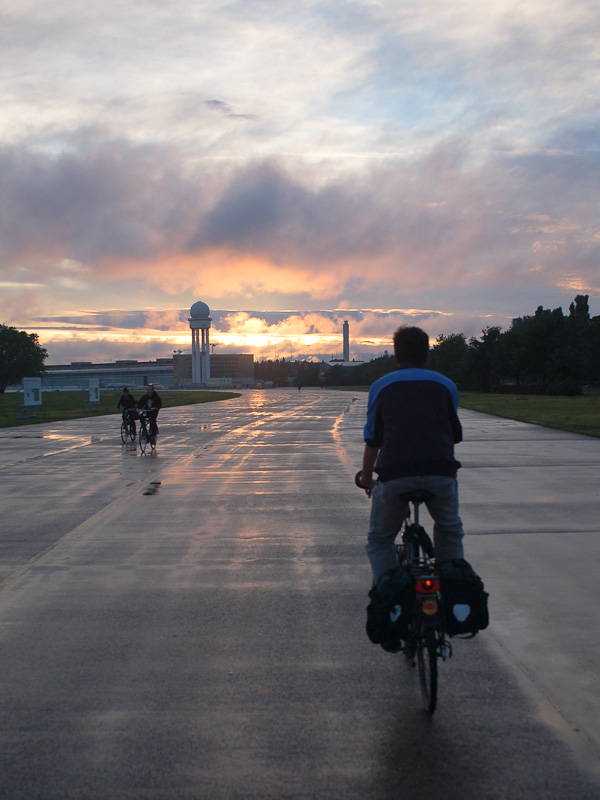
Having served more than four million travelers per year in the early 1970s, Berlin’s Tempelhof airport slowly lost importance. While it remained popular among more affluent travelers due to its central location, it only dispatched 350,000 passengers per year by the mid-2000s. Two larger airports had become more important, and construction work had begun to expand one of them into the single airport of the city. And so the authorities decided to shut Tempelhof down for good.
The closure of Tempelhof led to an interesting question: What do you do with 300 hectares of finest real estate if you’re one of the brokest cities in the country?
Surprisingly, instead of selling the prime premises right away, Berlin decided to temporarily open up the compound to the public. And while plenty of plans for subsequent usage have since been made (and discarded), the old airport has become what urbanist Nikolai Roskamm called a “utopia of nothingness”: a large-scale social experiment in the middle of the city, powered by slow bureaucracy, Berlin’s DIY culture, and a good dose of friendly anarchism.
Since the opening of the Tempelhof field to the public in 2010, thousands of citizens have not only visited the premises, but taken possession of them. People started cultivating lettuce and tomatoes. They went there to skate, to bike, to hike, to watch birds. They enjoyed relaxing in the sun. They organised events and courses and parties. And as long as they left the field at dusk, the authorities mostly left them alone. While some of these projects have been put into a legal framework by now, much of what we see on Tempelhof is happening without any license. It’s happening without cover charges, without feasibility studies, and without land development plans. The Berliners just began to use the empty space as if it was their garden.
Buy the complete back catalogue of New Escapologist with a 10% discount today.
Or buy the complete back catalogue on PDF, with £1 off the price each issue.
It’s a Free Country
You don’t hear it very often these days, but there used to be an extremely common expression, which seemed to have been coined mainly to get up other people’s noses.
That expression was, “It’s a free country”.
It could be used permissively:
Me: Do you mind if I smoke in here?
You: Go ahead. It’s a free country.
Or dismissively:
You: Could you please extinguish that smelly cigarette?
Me: Get stuffed, it’s a free country.
In either usage, it’s a rather feeble act of passive-aggression.
And what does it really mean? What the hell is a free country? It brings to mind some imaginary Third World country which isn’t “free” and people are forced by the State to have manners and be decent to one another.
Substituting “country” for “world” in the age of the Internet and generously overlooking the fact that we don’t live in a free country and one cannot always do what one likes, “It’s a free country” refers to the fact that we have a broadly Libertarian moral system. Few would disagree with the idea that “So long as your actions do not harm another, you’re free to do what you like”.
But there lies the problem. The entire problem with a Libertarian system is inherent in the expression “It’s a free country”. We too often forget the “So long as your actions do not harm another” proviso. Somewhere along the way, we’ve abandoned that important part of it and Libertarianism, now tried up with strong forces like the free market, has become equal to the statement “I’ll have my fun and that’s all that matters, woe betide anyone who tries to stop me”.
Which isn’t really on is it?
Buy the complete back catalogue of New Escapologist with a 10% discount today.
Or buy the complete back catalogue on PDF, with £1 off the price each issue.
Issue Eight Contents
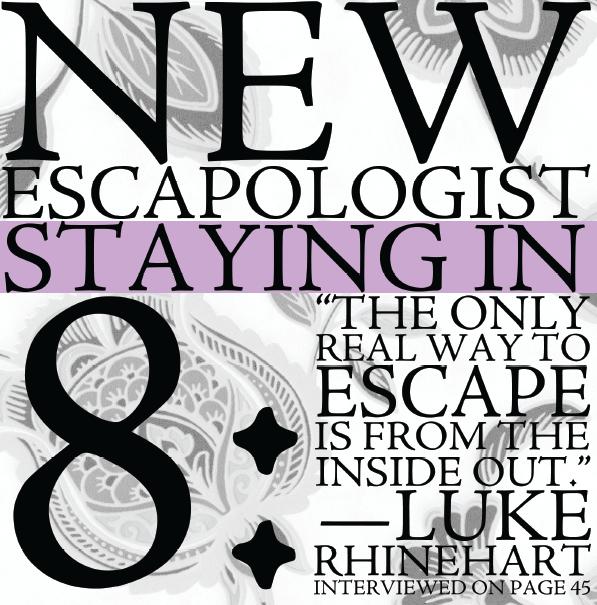
I’ve been travelling the world for a couple of weeks, but somehow managed to release a New Escapologist along the way.
Because of unreliable Internet while travelling, I didn’t post much about the actual contents of Issue 8, which in my opinion is our strongest and most pleasantly readable issue yet. Lots of funny stuff, light things, and practical nuggets. The artwork is also especially good this time and there’s a great interview with Luke Rhinehart to boot. The theme is Staying In and includes homey topics.
Here’s what the contents page looks like:
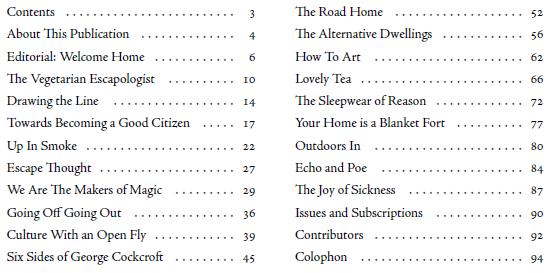
And here’s a breakdown of everything:
Editorial: Welcome Home. Robert Wringham on the good life and the merits of staying in.
The Vegetarian Escapologist. Mark Wentworth’s funny article on the merits of being a veggie.
Drawing the Line. Neil Scott on integrity.
Towards Becoming a Good Citizen. Interview with artist Ellie Harrison.
Up in Smoke. Matt Caulfield on the pleasures of cigars, and what that means to idle types.
Escape Thought. Neil Scott’s theory that it’s possible to think too much.
We Are the Makers of Magic. Steven Rainey’s fascinating article about home music production.
Going Off Going Out. A witty piece by Dickon Edwards about the effect of aging on one’s social life.
Culture with an Open Fly. Brilliant piece about the life and work John Cowper Powys, by Tim Blanchard. Hilarious illustration by Philip Dearest here too.
Six Sides of George Cockcroft. Robert Wringham interviews Luke Rhinehart, author of the famous and devastating novel The Dice Man.
The Road Home. Mark Wentworth on what home means to the seasoned world traveller.
The Alternative Dwellings. A guide to communes, squats, and tiny homes by Nicolette Stewart.
How to Art. A brilliant guide to art collecting for Escapologists, by Samara Leibner.
Lovely Tea. Robert Wringham on the perfect cuppa.
The Sleepwear of Reason. Reggie C. King defends those people who choose to wear pajamas out of doors or bring work into bed. Great artwork from Lawrence Gullo here too.
Your Home is a Blanket Fort. Good living tips from Sipaway Jackson.
Outdoors In. Hilarious article by Jon Ransom about how non-outdoorsy types might like to introduce nature into the home.
Echo and Poe. Alex Jorgensen investigates the fringes of the Internet.
The Joy of Sickness. Robert Wringham on the pleasures of illness and the concept of ‘Dark Epicureanism’.
You can buy Issue 8 in print or in PDF at the shop.
Issue 8 has also been added to the complete back catalogue package and to the complete PDF package.
Enjoy!
An Escapologist’s Diary. Part 33.
Time for a belated End of Year Review and Report to My Imaginary Shareholders.
The purpose of these Diary columns is to help answer the question of “what would I do if I didn’t go to work?”. So bear with me, while I rabble on about my year. I’ll keep it brief.
2012 was a pretty mellow year, very idler-friendly and without as many landmark events as 2011. The main thing has been adjusting to my somewhat isolated but luxuriously lazy life in Montreal: a city of extreme climates, both political and actual. This year, if I’ve been not navigating a tricky conversation in French or marching alongside protesting students with their proud red squares and V masks, I’ve been trudging through record-levels of snow and wondering why Pussy Riot-style balaclavas aren’t more popular here. Still, it all helps to keep the rent down.
New Escapologist Issue Eight out now!
Just completed before the year is out! Available, as usual, in print and PDF at the shop.
This issue features a very special interview with Dice Man author Luke Rhinehart.
Subscriber and pre-order copies will be shipped this week.
Dice Man interview
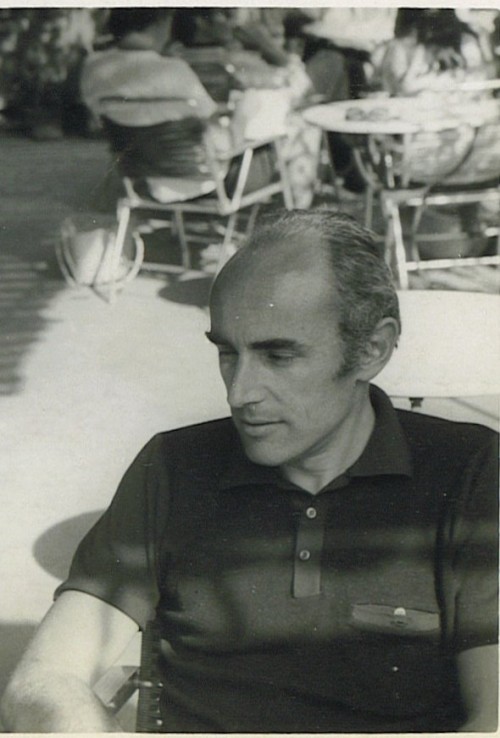
We can now announce the Issue Eight big interview. It’s surely our most exciting to date.
Ladies and Gentlemen, it’s the writer of The Dice Man: Luke Rhinehart.
Buy the complete back catalogue of New Escapologist with a 10% discount today.
Or buy the complete back catalogue on PDF, with £1 off the price each issue.
Reggie and Aislinn for Christmas

Our friends and regular New Escapologist contributors, Reggie C. King and Aislínn Clarke, are the masterminds behind Wireless Mystery Theatre.
Anyone who came to our Issue 6 launch party in Edinburgh last year will already have experienced their splendor.
A couple of weeks ago, WMT played to a thousand-strong audience at the Ulster Hall in Belfast. The show, Charles Dickens’ A Christmas Carol, was broadcast live on BBC Radio.
What better way to spend an hour of Christmas Eve than with this performance? Enjoy the show for free on the BBC iPlayer.
Congratulations are due to the WMT. It’s quite a thing.
Buy the complete back catalogue of New Escapologist with a 10% discount today.
Or buy the complete back catalogue on PDF, with £1 off the price each issue.
Flitcraft
In The Maltese Falcon, there’s a digression in which Sam Spade tells the story of Charles Flitcraft.
It illustrates a good part of the appeal of Absurdity to the Escapologist: the fact that you really can just walk away if you choose to.
Flitcraft is a modestly successful estate agent who, after narrowly missing being killed by a falling piece of masonry, decides to walk out on his life.
Flitcraft had been a good citizen and a good husband and father, not by any outer compulsion, but simply because he was a man most comfortable in step with his surroundings. He had been raised that way. The people he knew were like that. The life he knew was a clean orderly sane responsible affair. Now a falling beam had shown him that life was fundamentally none of these things. He, the good citizen-husband-father, could be wiped out between office and restaurant by the accident of a falling beam. He knew then that men died at haphazard like that, and lived only while blind chance spared them.
I came to Flitcraft via Oracle Night by Paul Auster, which includes a brief examination of the character and an expanded exploration of the idea.
Buy the complete back catalogue of New Escapologist with a 10% discount today.
Or buy the complete back catalogue on PDF, with £1 off the price each issue.