Welcome, new readers
We enjoyed a spike in blog readership this week after being mentioned on a couple of more prominent blogs. Huzzah!
I’d like to welcome these new readers. Welcome! I very much hope that you stick around for a little while.
In case you’re wondering precisely what all the fuss is about, here’s a little FAQ by way of an introduction:
What is Escapology?
It’s about deftly avoiding the potential traps of modern life: debt, stress, unrewarding work, bureaucracy, marketing, noise, and over-government. It’s about embracing freedom, Anarchy and Absurdity. It’s about overcoming miserliness, passive-aggression, mauvaise fois and submission. Escapology asks you to consider the circumstances in which you would most like to live and encourages you to find a way of engineering them.
What is this blog?
It’s the online companion to a magazine called New Escapologist (available to order in both print and PDF at our shop).
Both the blog and the magazine both discuss the above subject of “Escapology”.
The blog is updated regularly, but not to a schedule.
What is the magazine like?
Each issue is a compendium of funny and existential essays and anecdotes relating to Escapology. It is beautifully typeset, it is square, it is released to an irregular schedule, it is between 34 and 110 pages, and it can be purchased (in either print of PDF) here.
Who writes all this?
The magazine has writers and illustrators from all over the world. The blog is maintained by me, Robert Wringham. I’m the editor of the magazine and also a humourist and a stand-up comic and a bunch of other stuff.
What would I do if I didn’t go to work?
There are many options. Escapologists have reported enjoying travel; charity work; political activism; cottage industry; dedication to an art or craft; physical challenges; autodidactism; and decadent laziness. To go some way to answering this question, I maintain an online diary to document my post-escape life. It’s called An Escapologist’s Diary.
You talk about minimalism a lot. What does minimalism have to do with Escapology?
One of the most important things to strive for as an Escapologist is mobility. Each possession or dependency is a threat to mobility.
Why be a minimalist? Who wants to live in a white-walled box?
I’ll hand over to Leo Babauta (who fields more questions about minimalism here and here).
It’s a way to escape the […] excesses of consumerism, material possessions, clutter, having too much to do, too much debt, too many distractions, too much noise. But too little meaning. Minimalism is a way of eschewing the non-essential in order to focus on what’s truly important, what gives our lives meaning, what gives us joy and value.
Does your project have anything to do with Houdini?
He was the inspiration for it. We use escapology as a metaphor:
Houdini’s popularity as an escape artist came about during a time of technological and political revolution. It was during the 1900s that Ransom Eli Olds implemented the first mass production of marketable cars, Tomas Edison’s phonograph made a commodity out of music, and the colonial expansion of Europe and America prompted the birth of the somewhat unpleasant political period known now as New Imperialism. Technologies and movements initially plugged as liberating would soon be discovered by thinkin’ types to be nasty, horrible traps designed only to placate, segment and enfeeble. When people become dependent upon companies or governments to entertain them, to transport them, to plan their days and to import their goods, they forget what it is to be free, alive and autonomous.
The work of Houdini and his contemporaries escaped the province of curiosity – that of conjuring and ventriloquism – and into the universe of metaphor.
Taken from An invitation to New Escapology.
So that’s us in a nutshell. There’s more about us here, and you can further connect to our goings on via our RSS and Facebook page. Enjoy!
Buy the complete back catalogue of New Escapologist with a 10% discount today.
Or buy the complete back catalogue on PDF, with £1 off the price each issue.

Gunther Holtorf
BBC News reports on Gunther Holtorf who has been travelling the world for twenty-three years.
Back in 1989, as the Berlin Wall fell, Gunther Holtorf and his wife Christine set out on what was meant to be an 18-month tour of Africa in their Mercedes Benz G Wagen. Now, with more than 800,000km (500,000 miles) on the clock, Gunther is still going.
The German former airline executive has travelled the equivalent of 20 times around the planet in the vehicle – which he calls Otto. He says he has never had a serious breakdown. Recently in Vietnam, Canadian-born photographer David Lemke joined Gunther on one section of his epic journey.
It shows once again how a transitory, minimalist lifestyle can be more rewarding than a stationary, materialist one.
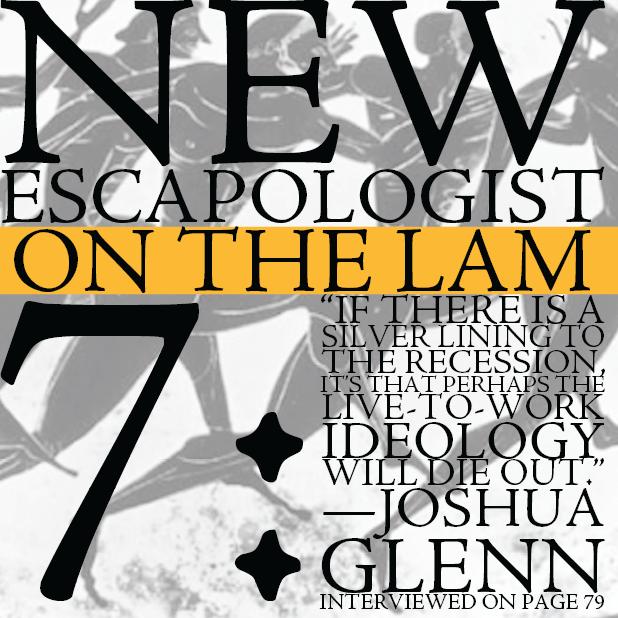
The forthcoming seventh issue of New Escapologist, “On The Lam”, will be precisely about transitory lives versus stationary ones.
Buy the complete back catalogue of New Escapologist with a 10% discount today.
Or buy the complete back catalogue on PDF, with £1 off the price each issue.

Best Escapological quotation ever?
Thanks to Heather for sending me this quote from Bukminster Fuller:
We must do away with the absolutely specious notion that everybody has to earn a living. It is a fact today that one in ten thousand of us can make a technological breakthrough capable of supporting all the rest. The youth of today are absolutely right in recognizing this nonsense of earning a living. We keep inventing jobs because of this false idea that everybody has to be employed at some kind of drudgery because, according to Malthusian-Darwinian theory, he must justify his right to exist. So we have inspectors of inspectors and people making instruments for inspectors to inspect inspectors. The true business of people should be to go back to school and think about whatever it was they were thinking about before somebody came along and told them they had to earn a living.
Originally from this 1970 edition of New York Magazine.

Buy the complete back catalogue of New Escapologist with a 10% discount today.
Or buy the complete back catalogue on PDF, with £1 off the price each issue.
Tony Ezzy Gets a Job
Montreal comedian/musician, Tony Ezzy, has a web series about getting a job. Episode 2 is rather funny and is called A Day at the Office. My favourites are the insane, crying receptionist and the weird hair-combing man.
Tony’s new life of working 12 hrs a day in an office with strange and frightening coworkers compares somewhat unfavourably to his old life of playing music, traveling and doing whatever he wanted whenever he wanted.
Buy the complete back catalogue of New Escapologist with a 10% discount today.
Or buy the complete back catalogue on PDF, with £1 off the price each issue.
New Escapologist now available in PDF!
Rejoice! By popular demand, New Escapologist is now available in downloadable PDF format.
Buy it today through the usual online shop. Just click the “Buy PDF” button and you’ll be directed to a secure Lulu shopping cart.
If you buy all issues in a single PayPal transaction, you will receive them (hopefully instantly) by email rather than Lulu download.
To keep things simple and in the spirit of New Escapologist, there is no Digital Rights Management imposed upon on our PDFs. This means you can share it with your friends, but for the sake of the project’s future, we’d encourage you to limit this practice. We’re using the honour system.
To reflect the lower production costs, each PDF issue is £1 cheaper than its print counterpart (making Issues One to Six £3, £4, £5, £5, £5 and £5 respectively). You will also avoid the shipping costs associated with the print editions.
Busyness
If your job wasn’t performed by a cat or a boa constrictor in a Richard Scarry book I’m not sure I believe it’s necessary.
Brilliant article by Tim Kreider in the New York Times about busyness and idleness.
Forbidden to be footloose
I’m becoming infatuated with the South African novelist J. M. Coetzee. Such spartan prose!
In his third-person memoir, Youth, Coetzee writes about working for IBM’s London offices in 1963.
Even though he worked on the cutting edge of technology, the practice was mind-numbingly dull; much unpaid overtime was required; and when his programming skills were lent in a minor way to the Cold War effort, the job caused him to contradict his personal ethics.
The account contains what must be one of the earliest examples of using a computer to skive:

He also writes of how the odds are sometimes stacked against the aspiring Escapologist:

Buy the complete back catalogue of New Escapologist with a 10% discount today.
Escapologia Digitalis?

The digitisation of printed materials is the most relevant topic in publishing and librarianship today. Boring, I know, but there we have it.
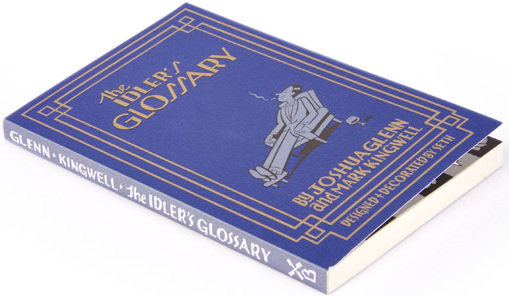
Just before he died, the great Ray Bradbury finally consented to a Kindle edition of Fahrenheit 451: a symbolic victory for eBooks if ever there was one. Even my own lovely book, published recently by Go Faster Stripe, comes with an instant PDF download when you buy the print version.
Even though I dislike eBooks myself, I’m beginning to think seriously about providing a digital download version of New Escapologist. It would not replace the printed editions: it would simply be another platform from which to read them. My motivation is a combination of the two strongest forces in the universe: peer pressure, and supply and demand.
Naturally, as a reactionary paperphile, I have reservations about this manoeuvre. On one hand, it is likely to be a profitable one, meaning we’ll be able to pay our writers and illustrators more regularly. On the other, it does feel like a slight ethical and artistic compromise. Let me explain:
We produce New Escapologist with a certain aesthetic experience in mind, and I feel this is compromised if a reader’s first exposure to the work is on a screen (likewise, I don’t intend to have the blog printed and bound at any point). Moreover, the entire ethic of New Escapologist is to live freely, which, we’ve always said, means severing dependencies upon pricey electronic gizmos. Moreover, I have a deep personal passion for books: real books. I don’t have much to say one way or another about downloadable PDFs, which means the ‘labour of love’ element of producing New Escapologist could also be compromised.
There are counter-arguments to all of my reservations, of course. Many of you feel that digital downloads facilitate freedom rather than hamper it because the lack of dead tree about the person will allow one to travel light. Moreover, the provision of a PDF download doesn’t directly contravene my love of books, just as the existence of websites or fortune cookies or sky-writing airplanes don’t: there’s arguably room enough in the world for all formats to exist.
Here are four reader arguments in favour of a digital edition:
– Dear Robert. Regarding your call for opinions on the digital editions, I would vote in favour of producing NE in PDF format, but in addition to the hard copy version. I like both formats but for different reasons. Hard copy is tactile and real but digital is convenient and accessible from anywhere. Perhaps you might consider subscription options that offer either or both formats: digital-only being cheaper to reflect reduced production and distribution costs, with hard copy at the current price but with complementary access to the digital edition. I’d personally favour the latter model.
– Hi Robert. Just a note on digital editions. As a minimalist, what puts me off buying the NE back catalogue is having to have them physically and move them around with me when I move (which I tend to do quite a bit). I know I could read them and give them away, but I’d rather have them for re-reading so would be more likely to buy if I could put [it] on my kindle.
– Hi Robert. A lot of the key magazines are giving free iPad compatible versions to their print subscribers as an extra incentive. However, don’t get me wrong I still love and fully appreciate the physical product… it’s just that sometimes I would like access when I don’t have copies handy (e.g. during a long plane journey, like today!)
– Hello! I stumbled upon this site via Click Clack Gorilla, and am enamored. I wanted to read the print publications as well, but I travel for work and currently live in Japan. I feel bad having things shipped all around the world to me, and then the dilemma of keeping them or passing them on once I move again. So, if there was ever a question of making the publications in PDF form, I am one vote for yes please!
And here is one well-reasoned reader argument against a digital edition:
– Hello. I think of NE as opposed to computer screens, and more importantly big business taking over our booknesses. I will never be ‘buying’ an ebook. You can’t flick through it, pass it on, use it for something it wasn’t intended. Ebooks (unless from free online libraries, I suppose) are eroding our freedoms, not helping them! I’m surprised some of your readers are happy to only read what Apple and Amazon let them. OK, perhaps if you were to sell the ebook file directly from your own website, which I could then download and put on my own device of choice, then that would be ok-ish. But I’m still always going to be buying the paper version. Maybe you could bundle the e-version with the paper one. Anyway, personally, NE is ‘goodbye to all that’, and that includes screens, batteries, plugs, wires and multinationals. And you can’t read on the iPad in direct sunlight, which really seems wrong for NE.
And in a personal email to a friend who had asked how to resolve Escapological minimalism with a love of books, I recently wrote:
– I have realised, after much thought on the subject, that there is no substitute for books. eBooks do not cut it for me. I cannot get excited about a “plastic pal” such as a Kindle or a boring bit of searchable software like a PDF or a DOC. Electronic book-reading devices would certainly solve the problem of physical book ownership, but my interest in books (as I imagine yours) extends beyond the information they contain. Part of a book’s soul is not in the words but in the typography, the binding style, the size, the thickness, the choice of paper, the odour, the width of the page margins, the weird little print anomalies or type errors. Even the vandalism, marginal notes, coffee cup rings, bookplates, hand-written dedications (“For George, Christmas 1963, Nana and Gramps”) from previous owners are part of the experience for me. You know when you buy a book and there’s a publisher’s advert in the back for alien-sounding books that don’t exist anymore and cost 2p? I love that more than anything! I love books – real books – and that is something this minimalist has to live with.
So there you have it. I’m really on the fence with this one, and finding it difficult to continue in my usual mode of benevolent dictatorship. If you’d like to support the life of paper and coffee cup rings, please continue to buy it. If you’d like to join the debate for or against digital editions, leave a comment in this post.
Buy the complete back catalogue of New Escapologist with a 10% discount today.
American Nomads
Thanks to Tom for pointing me at a BBC documentary called American Nomads. It’s terrific!
A journalist called Richard Grant interviews some interesting characters who’ve chosen a life on the open road.
Some of these nomads are true Escapologists: people who’ve abandoned affluent lives at various points and for various reasons. There’s a man in his thirties who quit an unsatisfying Wall Street career and took to the road. And there are the ‘snowbirds’ – older people who retired and sold their houses in favour of travelling the States in luxurious mobile homes.
There’s also a travelling minister, some homeless teenagers fleeing their abusive families, a few wondering nutters, travelling rodeo competitors, a young freight train-hopper, and a silver-haired mountain man called Yogi.
Worth a look if you’re curious about what happens without the securities of a home and a job.
Buy the complete back catalogue of New Escapologist with a 10% discount today.
New Worlds
It was a dizzying prospect — to imagine all that freedom, to understand how little it mattered what choice he made. He could go anywhere he wanted, he could do anything he felt like doing, and not a single person in the world would care.

I just read The Music of Chance by Paul Auster. Just look at his serious face.
It’s a tremendously liberating and satisfying novel. It’s Fight Club for grown ups.
In the opening pages, the protagonist takes a wrong turn onto an American freeway and ends up heading in the direction of the wrong city. Instead of correcting his mistake, he decides to carry on.
He feels giddy with freedom and is made aware of the vastness of the universe and the almost limitless possibilities we all face.
He quits his job as a firefighter and goes on a wide and aimless American driving adventure. Where it takes him is properly startling.
Now that he’d taken the first step, it wasn’t difficult for him to push on to the end. For the next five days, he took care of business, calling up his landlord and telling him to look for a new tenant, donating furniture to the Salvation Army, cutting off his gas and electric services, disconnecting his phone. There was a recklessness and violence to these gestures that deeply satisfied him, but nothing could match the pleasure of simply throwing things away. […] He felt like a man who had finally found the courage to put a bullet through his head — but in this case the bullet was not death, it was life, it was the explosion that triggers the birth of new worlds.
Psychogeographic. Absurdist. Existential. Zen. Mischievous. Situationist.
Buy the complete back catalogue of New Escapologist with a 10% discount today.