New Worlds
It was a dizzying prospect — to imagine all that freedom, to understand how little it mattered what choice he made. He could go anywhere he wanted, he could do anything he felt like doing, and not a single person in the world would care.

I just read The Music of Chance by Paul Auster. Just look at his serious face.
It’s a tremendously liberating and satisfying novel. It’s Fight Club for grown ups.
In the opening pages, the protagonist takes a wrong turn onto an American freeway and ends up heading in the direction of the wrong city. Instead of correcting his mistake, he decides to carry on.
He feels giddy with freedom and is made aware of the vastness of the universe and the almost limitless possibilities we all face.
He quits his job as a firefighter and goes on a wide and aimless American driving adventure. Where it takes him is properly startling.
Now that he’d taken the first step, it wasn’t difficult for him to push on to the end. For the next five days, he took care of business, calling up his landlord and telling him to look for a new tenant, donating furniture to the Salvation Army, cutting off his gas and electric services, disconnecting his phone. There was a recklessness and violence to these gestures that deeply satisfied him, but nothing could match the pleasure of simply throwing things away. […] He felt like a man who had finally found the courage to put a bullet through his head — but in this case the bullet was not death, it was life, it was the explosion that triggers the birth of new worlds.
Psychogeographic. Absurdist. Existential. Zen. Mischievous. Situationist.
Buy the complete back catalogue of New Escapologist with a 10% discount today.
An Escapologist’s Diary: Part 32. Unquiet Revolution.

Every evening this week at 8pm, we’ve taken saucepans and kitchen utensils onto the balcony and made a racket. Odd behaviour, I know, but we’re not alone. For twenty minutes each night, residents of Montreal make as much noise as possible. Those at home rattle their pans, motorists sound their horns, pedestrians cheer and shout and whistle. The symphony is heard across the city and everyone knows what it means.
Things are getting exciting here. As I type this, the apartment is filled with the sound of revolution: joyous pan-rattling from rooftops and balconies, shouting in the streets; urgent sirens and helicopters. Thousands take to the streets each night, waving red flags and chanting en Français.
It all started with campus-based student demonstrations opposing a $1,625 increase in tuition fees. But when the Quebec National Assembly attempted to quash the protests by initiating an emergency law called Bill 78 on May 18th, it somewhat fanned the flames.
It’s not just students anymore. The protest crowds and the saucepan-bangers are from all walks of life. People won’t tolerate such brutal top-down interference in what we’re allowed to do. Whether or not you disapprove of the fee increase, you probably feel that citizens have the right to peaceful protest.
On the street, people register their approval of the protests by wearing red squares of cloth pinned to their clothes. As the protests continue and the issues mature, more and more of these red patches appear. What was originally a student meme is now a mainstream gesture of mass objection. Statistics suggest that the majority of the public are not yet behind the protest (irritated as they are by the resulting traffic jams and metro closures) but the racket of the pans each night suggests that a large number of people support it.
A single street protest last weekend was apparently largest act of civil disobedience in Canadian history.
Tuition fees were the initial thrust of the protests, and residential disapproval of Bill 78 is a catalyst, but banners carried by the crowds suggest a wider dissatisfaction with the current government and capitalism at large. Many see the hiked tuition fees as symptomatic of the political corruption and gross financial mismanagement of the last few years. Since the 1960s, people have worked hard to guarantee a certain standard of public service and accessible education to help ensure a decent quality of life for all. It is a shame to let all of that disappear now.
Hundreds of thousands of street protesters marched past our Park Avenue apartment building last night, proudly flouting the demands of the emergency law. Hundreds will have been arrested.
Montreal’s mayor, says “we need to reclaim our streets” as if the protesters were a pesky minority and that he somehow stands with “us” against “them”. But the divide is not between miscreant protesters and right-thinking citizens. The divide is between residents and government.
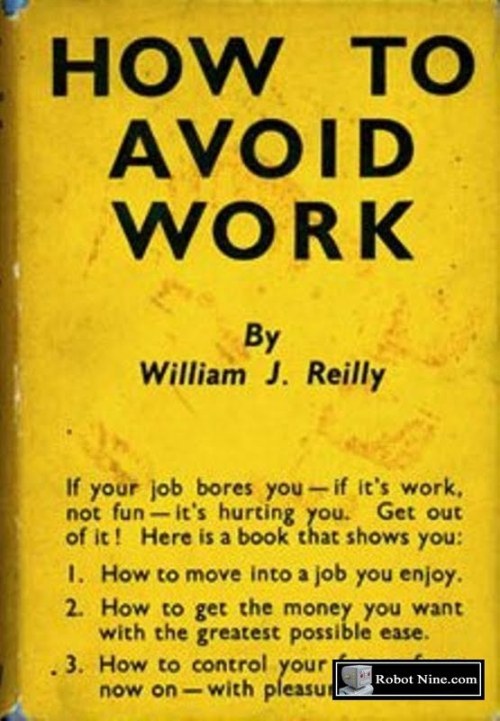
How to Avoid Work (or: Why Don’t You Do It?)
We discovered a 1949 book called How To Avoid Work when my girlfriend found a postcard reproduction of its dust cover for sale in the British Library gift shop. The book is out of print and usually costs a fortune but we were lucky enough to find a copy on Etsy for a tenner.
The book is terse, austere, and thanks to the passage of time, somewhat quaint. It’s basically a career guidance book with the central message that “work” can be avoided if we think carefully about the kind of job we really want. It’s a bit of a rip-off in that you’ll still have a career and a daily job if you follow this advice, but there’s wisdom in the notion that we don’t have to do work that contradicts our values or wastes our true talents.
Much of the book is too old-fashioned to still be applicable: there’s a funny chapter about ‘sponsorship’ – a method of landing a corporate job by means of informal schmoozing. There’s also an old-fashioned and hectoring lingo, and a strong assumption that the career-minded reader has external genitalia.
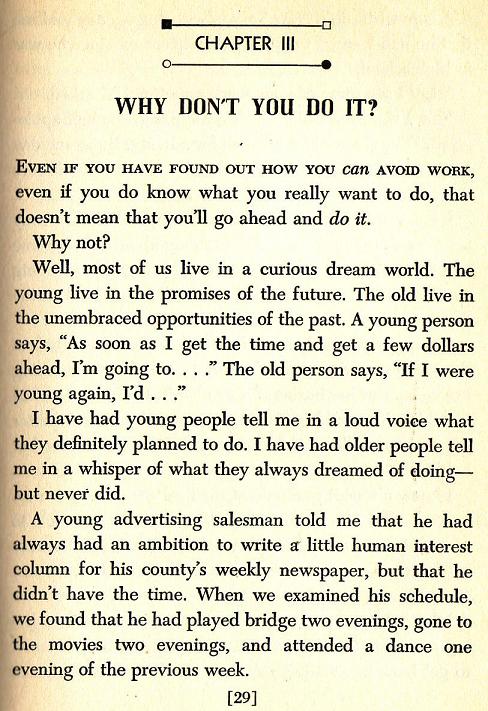
But there’s one interesting chapter called “Why don’t you do it?” which is ostensibly about New Escapologist‘s favourite subject: Bad Faith. It asks why so many people do things they don’t want to do (and fail to do the things they truly want to do). Here’s a little sample. You’ll probably agree that it still holds water.
No fear
When I quit my modestly paid day job, I felt very proud to have acted according to my will and to no other. But I was secretly scared of what would happen next. Would I end up destitute? Would I have to do things even worse than clerical work in order to avoid destitution?
Three years later, I’m still living on the money I saved from that job, supplemented by an income so small that most people (including those people who work at the tax office) consider negligible. They consider it negligible because they are addicted to a consumer lifestyle – the mild and dim lifestyle shown to us in magazines and on the television.
I am not a hermit or a monk or a dreadlocked radical. I did not “escape to the countryside” or go “back to the land” and I do not live in a squat. I live in a nice little apartment in the fashionable part of a civilised metropolis. I do not live in fear of what will happen next. I do not do work that I find undignified. I do not wait on tenterhooks for pay cheques.
I don’t have all the answers and I have no personal investment in whether people choose to continue on the usual treadmill or to escape it. But to those people who aren’t having a good time and aren’t too proud to take some advice from someone who doesn’t mind looking bit arrogant: try doing what I do.
Buy the complete back catalogue of New Escapologist with a 10% discount today.
You Are Nothing
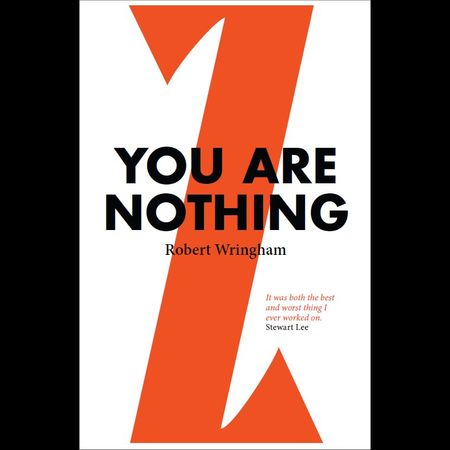
Admirers of the editor (and comedy fans alike) might like to hear about my first book, published last week by comedy media octopus, Go Faster Stripe.
The book is called You Are Nothing and (far from being a self-help book with a title like that) is an “unreliable history” of the avant-garde early work of super-comedians Stewart Lee, Roger Mann, Simon Munnery, and their amazing friends.
I’ve loved Go Faster Stripe since they were formed in 2005 and I’m profoundly happy to have produced something with them.
Properly against the grain in style and in subject, You Are Nothing was a thrill to write and will be thrice as thrilling to read (lest my eyes be plucked from their sockets by a tribe of the commonest wooodland mammals).
Read more about the book (and place your order if you like the sound of it) here.
350,000 quid
I really can’t get enough of Dear Jeremy, the career advice column in The Guardian. Reading about other people’s work problems (from petty office politics to tedious career choices) is a good way to remember the Great Terror from which I narrowly escaped. It can only keep me on my toes, eh?
This week’s column features a most escapological conundrum. A fellow wants to escape his day job with £350,000 of assets. He plans to invest it in a new business of his own devising: a bed-and-breakfast hotel.
While his adventurous spirit is admirable, a friend really should take the chap by the lapels and say something along the lines of “ARE YOU CRAZY? THREE AND A HALF HUNDRED GRAND IS THE ESCAPE FUND OF A LIFETIME! SEVERAL LIFETIMES IF YOU’RE FRUGAL!”
To have raised such a handsome battery of wealth (and presumably to be debt-free) seems to be a case of “mission accomplished” to me. I certainly wouldn’t invest it in such a financially risky and time- and energy-consuming endeavor as a B&B. Hasn’t he seen Fawlty Towers? Out of the frying pan and into the fire.
I suppose it depends on his overheads: the affluent consumer lifestyle is an expensive commitment. I’d just curb my consumer desires, retire at once, and spend the money slowly on top-notch cakes for the next fifty years.
Buy the complete back catalogue of New Escapologist with a 10% discount today.
Things of value
What things are required for a pleasant life? Here are my answers.
– optimum health;
– as much free time as possible;
– a few dependable friendships;
– an appreciation of your existing surroundings (which can be enhanced through the basic study of astronomy, botany, architecture, culture, aesthetics, psychology, etc);
– sensual pleasure;
– the confidence to speak your mind;
– a satisfying creative output, in which you have personal pride;
– a clean and dignified living space;
– a modicum of peer recognition;
– some good habits to be proud of;
– few dependencies;
– few secrets.
Not many of these things are commercially available.
This is not an attempt at fabricating a mawkish, real-meaning-of-Christmas-style consolation prize. This is what I’ve found, so far, to be true.
Buy the complete back catalogue of New Escapologist with a 10% discount today.
Barn Raising
We use Escapology as a metaphor. You probably already knew that. Where Houdini applied his intellect, physical prowess, and showman pizzazz to escape handcuffs and water chambers; we learn to do the same for traps like financial debt, poor schooling, boring day jobs, unsatisfying materialism, commercial dependence, tedious monogamy, and urban lethargy.
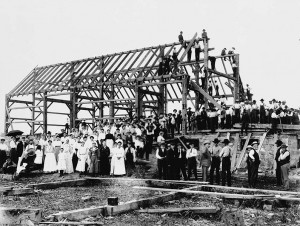
I just learned about something called barn raising. You probably knew about that too, but I’m such a city slicker and historical ignoramus that I’d never heard of it before.
It strikes me as a great metaphor for collaboration. If everyone chips in, these big, difficult, potentially expensive things just happen. And later, you can take the opportunity of being together to all get drunk and dance.
I suppose it’s like what Vonnegut used to say about the advantages of extended families.
Maybe there should be a metaphorical barn raising internet community. Twenty people join the community (or a sub-group of that community) and they all pledge their barn raising services to the group. Everyone must chip in to help with a sizable project initiated by one member of the group.
If Fred wants a to lay a patio at his house, everybody comes along and makes the project happen over a pre-planned period of time. If Marge wants to assassinate a major world leader, they all club to together Julius-Caesar style. (I’m just kidding about the assassination, but you get the picture).
It could be destined to failure. Would there be too many freeloaders? Would there be an imbalance in individuals’ skills? I can typeset a book for you, but I’m not the greatest when it comes to damp-proofing a cellar. Food for thought though. An attempt at loosely-organised, mutually-beneficial cooperation in the fashion of barn-raising could be a viable alternative to the usual solution of throwing money at a project and hoping it goes away.
Buy the complete back catalogue of New Escapologist with a 10% discount today.
Cashless
Mark Boyle is chap from Britain who lives without money. I used to read his stuff in the Guardian, but I’d sort of forgotten about him until my friend Greg posted a link to his archived columns today. I hope Mr Boyle is still going strong.
What have I learned? That friendship, not money, is real security. That most western poverty is of the spiritual kind. That independence is really interdependence. And that if you don’t own a plasma screen TV, people think you’re an extremist.
Mark lived in a caravan, powered his laptop and telephone with solar power, ate homegrown and foraged food, and spent his time writing and using his laptop for activism. None of this cost a penny after the initial setup. I may be wrong, but I think he lives in an eco-village now, still independent of money.
Like many Escapologists (from no-money caravan dwellers to big-money extreme early retirees), Mark shows it can be done. With a little perseverance in one direction or another, we can break away from conventional habits and have more rewarding, more efficient, greener lives. It’s not just for our own benefit either: removing oneself from the cash economy is for everyone’s benefit, no matter what those growth-enthusiasts say.
All I am trying to say is that I believe money is like oil: if we are going to use it, let’s at least use it to build sustainable infrastructure for the future, and not meaningless tat.
This is probably a nod towards E. F. Schumacher’s Small is Beautiful, in which the economist suggests we use fossil fuels only as capital investment: that is to use them only to build better, more sustainable energy resources and infrastructures. We’re starting to do that now, especially in places like Germany and Scotland but it took way longer than it should have done.
Buy the complete back catalogue of New Escapologist with a 10% discount today.
Good Gough
Regular reader François draws our attention to this Escapological quote from the Naked Rambler, who is sadly in prison again.
I wasn’t working. I spent my time looking after the kids and going for walks. One day I was walking and something happened. I realised I was good. Being British, buried in our upbringing is that we’re not good or have to watch ourselves – maybe it comes from religion, or school. I realised that at a fundamental level I’m good, we’re all good, and you can trust that one part of yourself.
Originally from an article in the Guardian.
What Stephen Gough says is correct. You are good. You’re not a human resource for someone else to exploit. Don’t allow yourself or other good people to be pushed around by gods or governments.
Buy the complete back catalogue of New Escapologist with a 10% discount today.