Life in a Cornish Shed

[The tourists] stopped their cars on the crossroads and spent ages trying to capture my shed with their expensive cameras. I couldn’t understand it at first. My shed was not typical of Cornwall. It wasn’t picturesque, like the granite cottages. I decided, in the end, that the shed must have looked like freedom. It was clear, by then, that someone was living in the broken-down building. Someone–me–had managed to escape.
In Escape Everything! there’s a chapter in which I describe the lives of hermits, people who have gone off into the woods to live in sheds or lean-tos. My tongue was half in my cheek when I wrote that. I wasn’t really suggesting that anyone go live in a shed, while also allowing that one could. One really could do it, and I gave some examples of it.
The reason I did this is because the extreme idea of going out into the woods and not coming back–being legally homeless and living by your wits–is perhaps the worst case scenario (WCS) and, as I say elsewhere in the book, it’s important to identify and understand the WCS. Not only does it show you, clearly, what you risk and so you can own you fate but also you’ll find that a specific WCS probably isn’t as bad as the general sense of “ULTIMATE FAILURE” you might otherwise carry around.
Now, a great and well-told book-length case study of living in such circumstance comes from Homesick: Why I Live in a Shed. It’s a brand new book by Catrina Davies and I can’t reccomend it highly enough.
Catrina lives in an abandoned metal-sided shed that once served as her dad’s workshop. Although it was rough circumstance–family poverty, the housing crisis and, ultimately, capitalism–that led Catrina to her unusual dwelling, she approaches the situation with a beautiful Stoicism and finds that it at least dovetails with her values. At least living in the shed, practically for free, means she can write books and songs instead of slaving in horrible jobs to make ends meet and pay the rent on someone else’s overrated property. Her impact on the natural environment she loves so much is minimal.
The book goes into how she made it all work (getting the water mains online, furnishing it), the horrors (having to evict spiders and rats when first moving in), the heartbreak (being burgled and then crashed into by a car), and the moments it truly pays off (swimming with seals, gazing at the moon and stars).
The book is available now and is clearly an important addition to any Escapologist’s library. ’tis good!
New newsletter coming atcha this week! Sign up here if you’re not already in.
Absconding
Say you could still just bail when you felt like it. You know what you would look like when you did it? You would look like this raccoon.
Many thanks to reader and supporter MV for bringing this absconding racoon to our attention.

The Hairpin commentary on the racoon is a tad bleak. It posits that we can’t abscond anymore because “there is nowhere left to bail to. The darkness is closing in on all sides.”
I know what she means. Workers’ rights are being eroded. The precariat swells. Free movement is under attack. But I’m still at large and if I believed for a second that escape was impossible I’d lose my final marble.
“Happy to discuss,” as a bastard might write at the end of workplace email.
New newsletter coming atcha this week! Sign up here if you’re not already in.
Letter to the Editor: They Just… Lost Track of Me
To send a letter to the editor, simply write in. You’ll get a reply and we’ll anonymise any blogged version.
Hi Robert,
Re: the intangibility of debt. When I was 20 or so, I took out a $5,000 personal loan and a credit card with a $5,000 limit. The loan was to pay for the removal of my wisdom teeth and the credit card was because I thought it was just a thing adults are supposed to have.
I ended up moving overseas for two years instead of making any attempt to pay them off, and in that absence they just… lost track of me.
A few years later, I applied to get a copy of my credit report and there was no record of either of the defaults.
The only info they had on me was an address I used to live at, and one of the many jobs I’d (officially) worked at. There was almost no detail whatsoever. I’m not off-grid or anything; I’m on the electoral roll and I pay taxes so it’s not hard to find me.
So, yeah. I don’t think the whole red letter, scary-scary, “protect your credit rating at all costs” thing is real.
I think I probably got lucky – but only a bit. It was two unrelated financial institutions, so I think it must be pretty common. I figure the people who attend to low-level debt are just random people who aren’t great at their jobs and don’t care about them (nor should they), so of course it doesn’t get tracked well.
I don’t know if I can go as far as actually recommending people just stop paying their consumer debts off, but I can definitely recommend that people not feel like they are under a perpetual dark cloud. Because the bank sure as hell as isn’t thinking about it.
Yours,
Q
Happy Halloween!
They’re independent fellas
They don’t live nine to fives
Monsters lead such interesting lives.
Everything I Wanted To Do
I just gobbled up Neil Gaiman’s little book, Art Matters. It’s a collection of thoughtful bits and bobs, including a speech he gave to new arts graduates, on the subject of art and writing.
It’s eminently quotable and there are a couple that will resonate with Escapologists:
I escaped from school as soon as I could, when the prospect of four more years of enforced learning before I’d become the writer I wanted to be was stifling.
And, most importantly:
The nearest thing I had [to a plan] was a list I made when I was 15 of all everything I wanted to do. … I didn’t have a career, I just did the next thing on the list.
That list is pretty much the same thing as the “life audit” I suggest making in Escape Everything! and NG was obviously very clever to do it at 15. It’s never too late though: stand back, take stock, and decide what it is you want to do.
The possibilities are endless. If not Endless.
New newsletter coming out tomorrow! Sign up here if you’re not already in.
Letter to the Editor: 6 Months Away From Escape
To send a letter to the editor, simply write in. You’ll get a reply and we’ll anonymise any blogged version.
Hello Rob,
Escape Everything! has been a much-needed source of reassurance and motivation for me over the past several months. Thank you for creating this book! After I finished it, I immediately started reading again, this time keeping track of my favorite passages.
My husband and I created our Escape Plan about a year ago, and I found the New Escapologist site shortly after that. We are about 6 months away from Escape. We are going to quit our jobs, sell our house, and take an extended road trip.
In Chapter 9 you joke about stating to one’s employer “I just hate work and want to be free” as a reason for wanting to work fewer hours. I had a good laugh and am seriously considering using this line when I resign from my job!
Thank you so very much for sharing your wonderful writing and point of view.
-V
A House From Scratch

The final house inspection by the Nanaimo Regional District building inspector was on May 3, however it took a couple of more weeks to secure the occupancy permit as we had to replace the glazing in a stair bottom window with tempered glass so the inspector could sleep at night.
I’ve posted about it before (and possibly mentioned it in EE!) but New Escapologist contributor Rob West and his family have been building a house in British Columbia, escaping a stressful life in expensive London and Vancouver.
Well, after five years, they’re moving in and it’s a beauty. Look at that circular window! Congrats, Wests.
Psst. Subscribe to New Escapologist essays on Patreon today.
Drawlloween: The Terrible Workplace Humour Edition
New Escapologist‘s art director Samara is taking part in a drawlloween thing for the duration of October. The idea is for artists to illustrate a different Halloween concept each day according to prompts set in advance.
As well as following the prompts, Samara’s chosen sub-theme is “terrible workplace humour,” so we get to see what various Monsters of Horror would look like if they had day jobs.
Today’s prompt is “Cryptid” so she gives us the Mongolian Death Worm as if it worked in an office:
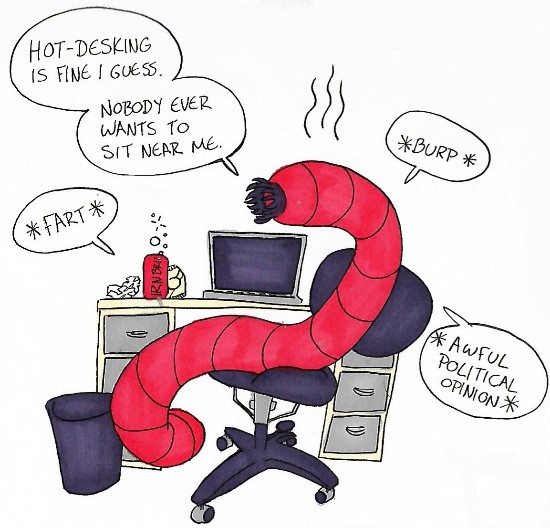
Samara says:
This is the Mongolian Death Worm, which releases a miasma of poison that kills anything it touches, and also chews loudly and reads its emails out loud to itself.
Check it out and, if you’re on Instagram yourself, give her some likes of encouragement.
Except The Impossible Things
These quotes are from Trawl, a 1966 novel by B. S. Johnson, further evidence, if any were needed, that a hatred of dreary employment runs through our literature, being so close to the human heart.
What I made money from [seemed] irrelevant, arbitrary, and I felt it should not be. One thing I did decide, was sure about, was that was that I was not going back to being a bank clerk as I had been in the six months between leaving school and being called up: I could not stand any of the work, the people, the atmosphere. But what I would do I just did not know, and could not think: and I could not even think of anything I would like to be, except the impossible things, like a writer, or a film director, or just rich.
I had gone at fourteen to a school which specialised in turning boys into clerks and accountants, and girls into typists and secretaries: and could therefore keep accounts, type, even do shorthand, though very slowly, and was fitted, even trained and qualified after a style, to be a clerk in some sort of office: which fitting was dismaying to me after my experience at the bank. The point was that such work involved repetition, often quite complex repetition, but nevertheless the same sort of thing day after day after day.
Psst. Support New Escapologist at Patreon for a new and interesting season of monthly(ish) essays. Or join our mailing list for a free monthly newsletter.
An Escapologist’s Diary: Part 58. Moment.
I’ve just returned from a whistle-stop tour of England. Well, London and Birmingham and bits of the countryside anyway.
A fine time was had, but when I saw an otherwise-pretty country cottage plastered with Brexit Party logos and slogans, I felt a surge of genuine shock. I wouldn’t want a world so homogenised that people didn’t have different ideas on how to run it, but my life is so insulated from hardcore Brexit sensibilities by living in Scotland and rarely visiting anywhere other London when I venture south, that it felt like I’d seen a house emblazoned with swastikas.
I’m willing to accept that this might say more about me than it does about the world. Nobody yet knows how history will see the present moment, but as a rootless cosmopolitan I found it chilling to say the least. It’s the idea that this madness was present all along–all through the sanguine ’90s and the neolib noughties–lurking darkly and burning hot.
Around the time of the EU Referendum, I saw some graffiti in Glasgow that read, “Let all the poison that lurks in the mud, hatch out.” This turns out to be from I, Claudius by Robert Graves (from whom, incidentally, New Escapologist takes it’s subtitle, “Goodbye to all that”). Maybe this is what we’re going through: letting the poison hatch out, getting some bile up for a nation’s health and a better world, the cottage I saw being but one manifestation of this. I’d like to believe it, but I don’t. I think there’s years of this bullshit yet to wade through and there will be huge amounts of additional damage to control.
Something else. There’s been an aesthetic change in England since I’ve been gone. Things feel distinctly folksy and anti-Modernist in a theme parkish way well suited to the era of Amazon and Etsy. I saw lots of people wearing tweed waistcoats and Peaky Blinders caps, and everything now seems to be covered with bunting. These pretensions to “vintage” style are aligned somewhere between hipster and UKIP, a Wartime tweeness represented in cutesy little cakes, pinafore strings, the union flag, electro-swing, and stocking seams. It all seems to say “This is as it should be,” but the aesthetic has confused authenticity with kitsch. I can just see them all huddled in bunkers after the Union and the EU, singing “we’ll all go together when we go” and believing it to be a consoling English song. The English are bringing back Their Day, reimagined and remixed through the lenses of nostalgic conservatism, CAD technologies, and an online shopping experience that grants people whatever they want. What they want in provincial England seems to be a sort of Replicant village May Day, Empire without the Empire.
Hey, do what you like! But please remember to also do the right thing.
*
I witnessed further historical moment in London when rubbing shoulders with Extinction Rebellion. I joined a small Idler contingent at Trafalgar Square for a “Do Less” campaign proximate to the somewhat larger XR disruption. I was over two hours late, which means I win at idling.
The event was quite exciting. I’ve been to lots of protests and marches and Anarchist or Socialist events over the years, but there was a palatable sense here that the protest was a genuine interface with Power, that They might be paying attention. Who knows?
At first, I wasn’t sure I’d be able to climb to the level of the lions on Nelson’s Column, but Tom and Brendan and Flo offered encouragement: “Just get your knee up!” I’ve said it before: the strongest force in the universe is peer pressure.
Flo has filed a nice and more detailed report at the Idler website:
Also present was Robert Wringham, Idler contributor and frugality expert. Robert doled out cheese sandwiches at Nelson’s Column to keep starving editor Tom Hodgkinson from going full anarchist and smashing up a police van. Thankfully he arrived at just the right time for lunch, or we may have been making this report from a prison cell.
We sang Lie Down And Be Counted by Neil Innes to the strumming of Tom’s uke. I’ve been suffering from laryngitis and so my deeply-hoarse Larry David (Larynge David?) voice was extremely audible over the others, especially when I routinely came in early on “what are we standing for.”
*
I missed my Patreon deadline last month because I decided that my essay about tiny houses wasn’t quite up to scratch, so nobody was charged. This is the kind of quality control you can expect from New Escapologist. Will there be an essay at the end of this month? Join us on Patreon to find out.