Who Wins?
In a world without work, some new science suggests, being busy will be the ultimate status symbol.
The article reporting this news also suggests that the new findings are at odds with the old Thorstein Veblen theory that the ultimate status symbol is leisure, the winners being those who can afford to spend time doing nothing.
What do we, Escapologists hoping for a toil-free future, think of that?
Well. As we already know (see Escape Everything!), work and consumerism are two sides of the same coin. They’re the same economic transaction seen from opposite ends. So the new science isn’t at odds with Veblen at all: the person with the most leisure time and the person with the biggest workload will be seen as equally impressive. It is already the case and it will still be the case in a post-work future too.
The kind of leisure currently and increasingly seen as a status symbol doesn’t involve lazing around like a lotus eater or slowly walking a tortoise like a 19th century fopp. Social capital is only dished out for those who actively participate in leisure industries. The gym, tourism, shopping. Nobody admires the efficient soul who gets through the week without breaking a sweat.
Moreover, the kind of work and busyness currently rewarded with social capital isn’t the useful work of wiping elderly bottoms or raising helpless children, but non-essential busy work. The CEO, seen as a great leader and a productive member of the international society, is extremely busy despite their work being essentially useless and even harmful to their own health and the world in general.
So in the post-work future, who will be seen as the winner? Those with the most leisure or those with the most hair falling out from busyness? It’s the same guy.
The only way to break the cyclical curse of this is to be an Escapologist and learn how to idle properly.
New Essay Series Begins
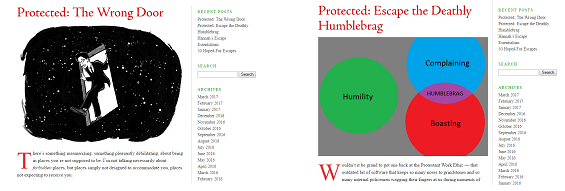
The new essay series is go! Subscribers and the generally keen-of-eye will have noticed this already.
I’ve received some nice email about the series already, so thanks to everyone who has fed back and given moral support as well as monetary.
I hope to post a new essay each month. I’ll also post an improved and updated director’s cut of an older essay from the archives, gradually building up an online Escapologist’s library.
The first new essay is called ESCAPE THE DEATHLY HUMBLEBRAG.
The first one from the vault is THE WRONG DOOR, first seen in Issue 8.
This content is exclusively available to subscribers, so chip in a tiny amount of money here if you want to join the party. All of your dosh gets ploughed back into New Escapologist, paying for the website and the essays and potential future projects.
Hannah’s Escape

I’ve been reading some Hannah Arendt and already I’m smitten.
I recommend reading her work (especially now — she wrote about fascist totalitarianism) but all I wanted to mention today is the glorious way Arendt and some others escaped the Nazis during the war. Get this:
There was a family who had a house with a front door in Germany and a back door in Czechoslovakia. They’d invite people over for dinner and let them leave through the back door at night.
I wish I had a house like that, perhaps embedded in Hadrian’s Wall. Might apply for art council funding.

50 Hoped-For Escapes
I once mentioned a website called 43things. It doesn’t exist any more but I wrote a note of something I found there. (Update: the site is back!)
43things was a social network about personal ambitions. You’d enter your dreams and goals and other people could cheer you on. When successful, you could write a little post about how you did it and whether it was worth it.
I mainly used it to eavesdrop on other people’s life plans.
I once popped the word ‘escape’ into the in-site search engine and came up with some 472 items. The result was like a measure of gross international unhappiness. Or at least dissatisfaction. Or, more positively, a measure of people’s desire to put things right in their lives.
Many of the ‘escape’ ambitions are either similar to other ones or don’t make sense, so I’ve boiled them down to a single report of 65 hopes for escape. It’s almost like a poem, composed by the Citizens of the Internet, circa 2013:
Escape the masses
Escape from Google
Escape into nowhere
Escape my past
Escape from this city/country
Escape the cubicle
Escape America
Escape from Alcatraz
escape death
escape reality
escape society
escape capitalism
Escape my parents
Escape From Jail
Escape materialism
escape Suburbia
escape from it all
Escape escapism
Escape…(for a while)
escape from myself
escape to a rainforest
Escape solitude
Escape from Zajecar for a while
escape from my life
escape winter
escape poverty
escape by train
Escape Debt
escape depression
Escape England!
escape the office
escape the routine
escape the midwest
escape the “curse”
escape from my ego
escape Nottingham
escape to paradise
escape plastic
Escape from Shawshank
Escape religion
Escape Ireland!
Escape from Iran
escape from LA
escape tradition
escape everything
escape from intolerance
Escape anxiety
escape from the matrix
escape to scotland
escape a life of corporate servitude
Pssh, I could tell you how to do any one of those.
The Mysticism of Work

Found in a zine by Amy Peltz, a quotation from Simone Weil:
Why has there never been a mystic, peasant or worker to write on the use to be made of disgust for work? Our souls fly from this disgust and try to hide it from themselves by reacting vegetatively. There is a mortal danger in admitting it to ourselves. This is the source of the falsehood peculiar to the working classes.
There has now, Ms Weil. It’s New Escapologist!
Of Design and Destiny

Must modern cities be ugly? Of course not, and they are not. But I walk past this “Skypark” thing quite often and it’s horrible. I mean, look at it.
It stores a few hundred teleworkers between 8am and 8pm, which is an act of evil in itself, but must it look like one? I’m only a passerby — I don’t deserve to be insulted.
“Know your place,” that building says, “You’re a cog in a machine in a grey, grey world.”
I like to wear a colourful pocket square when I know I’m due to pass it. It’s on a street corner with a lot of traffic, so I sometimes play with my yo-yo while waiting to cross.
“Such frivolousness,” the building says, “Earn your pittance! The grave is your destiny, so get trudging!”
Everyone likes the idea of beauty but we’re increaingly turning our backs on it because of some vague notion about the importance of professionalism and seriousness. To be beautiful is to be eccentric or profligate.
Design today must apparently be hard-edged, sober, practical, sturdy, and — while actually very expensive — look cheap. That, or it can be beautiful and temporary and safely stashed in a museum where nobody will see it.
To add a little flourish or some colour or nuance — or even to spell something properly — is seen as increasingly anachronistic.
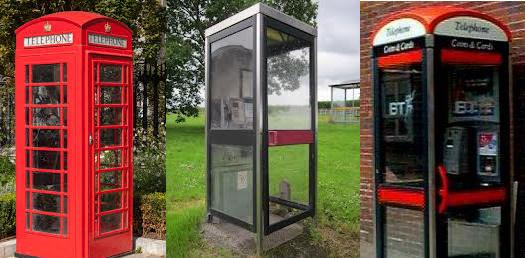
I’m always cheered to see a red telephone kiosk. It’s a design classic, it works, it’s an internationally-adored symbol of Britain. It’s cheap to use, it’s practically indestructible, and it can be trusted to deliver. Most of us would love to have one on our street corner, but we can’t apparently.
BT started getting rid of the red telephone box in about 1985, planting those horrible black perspex ones instead. You just know this was the result of a meeting in which some influential philistine said “the classic red telephone box does not reflect BT’s corporate values.”
The new kiosks said everything about municipal mediocrity. “Don’t go thinking you’re part of an empire,” it said, “don’t go thinking you’ve got better things to do than go to school and get a job and die.”
I mean, look at that one in the middle. They were routinely vadalised but how could they not be? I’d love to smash that one in. It’s practically what they’re for. In response to this public disdain and an outspoken nostalgia for the classic red box, BT brought out a happy medium which looked a bit like the shitty modern ones but with a domed top reminiscent of the classic.
The message was “Yes, everyone likes the classic… but we can’t have it because of the way the world is going. Nobody likes the modern version, but we have to have it this way. Haven’t you heard of inevitable decline? You have to work pretty hard to fulfill a thing like that.”
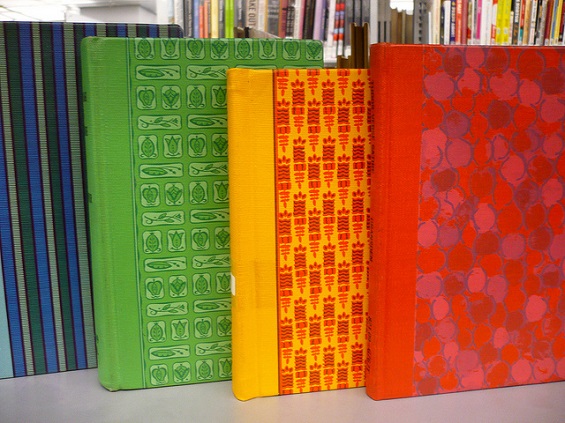
I once visited the Central Public Library in Seattle — a great building designed by Rem Koolhaas — and saw many beautifully-bound books inside. A one-time librarian, I knew the story of these books just by looking at them. The library once had its own bindery in which many old books were carefully rebound to extend their lives. Beautiful materials were chosen to bind the books so they’d be pleasing to the eye. The bindery was closed circa 2002 “because that’s not how things are done today”.
The present day is about Kobo and iPads, not beautiful, free-to-borrow books no matter how much we like the idea and how much sense it makes. Imagine a world in which people carried these books around the city instead of e-readers. It would be beautiful but we can’t have it because of an imaginary landscape called “the way the world is now.”
It’s a destructive logic causing good ideas to be stifled at birth or else scrapped after decades of flawless service. All because of cultural pessimism. It’s as if our national and international misery is seeping upwards into our design.
The implication is that we live in a time of austerity, utility, uniformity, corporate values, plasticity, disposability. Our period cannot be allowed to be one of domesticity, prettiness, happiness, dignity, peace, quiet or luxury.
The idea is that everything is doomed. It suggests there’s no alternative, that ugliness is inevitable, and that the destiny of all material — including human brainstuff — is to contribute to this harsh and sober vision.
But it’s not destiny. It’s all unnecessary. Britain and America are among the richest countries in the world. We’re producing more artists and designers than ever before. The world doesn’t need to be about the bottom line. Bladerunner was a warning, not a blueprint, yet look at the state of the London skyline: symbolic of little but graceless corporate guzzling. “Skypark,” meanwhile, sounds like something from Terminator 2: Judgement Day, a world where robots are in charge and love is on the scrap heap.
It doesn’t have to be this way, my pretties. Design your own lives. Act, move, earn, and speak beautifully. The others will join in sooner or later. Act as if you lived in the early days of a more beautiful world.
Let’s Not Give Them an Inch
Remember Chiune Sugihara? He was the Japanese diplomat in Lithuania who, during World War II, went over his bosses’ heads by issuing exit visas to thousands of Jews whose lives were threatened by the Nazis.
We posted about him at New Escapologist because he used his free agency where others would have denied it. He was a cog in a machine but he refused to act like one.
I don’t think it’s fanciful to say that many of us will be given the opportunity over the next few weeks, months and years to act as Chiune Sugihara did. Some have already risen to the occasion.
Challenge racism wherever it arises. We too often tolerate intolerance.
Never play devil’s advocate by saying “well, at least the actions of Trump/May/Farage/White Supremacists will give us [blank].” Don’t look for silver linings in blatantly unconscionable acts. No potential gain is worth what they’re doing.
Do not look to their followers and confuse their cowardice, ignorance and spite with an appetite for change.
Do not pull your punches. Do not give them an inch. They’ve already taken their mile.
Whenever you get a chance — and you will get chances — use it to do the right thing. Your opportunity may not come in the form of saving six thousand lives with a signature, but you should still look out for that fork in the road where you can grind like a cog or step up like Sugihara.

Expletive Deleted!

I’ll probably not post much more about Universal Basic Income to this blog (though I reserve the right to tweet about it) lest NE become too one-note while there’s so much going on with UBI. As this article puts it:
There has recently been a surge of interest in basic income. […] Long derided as unaffordable and conducive to idleness, basic income is now attracting support from many quarters and standard objections have been robustly challenged. This interest has prompted the launch of several basic income pilots around the world. One started on 1 January in Finland with others planned in Ontario, Canada, Oakland, California, Aquitaine and Catalonia, and discussions are ongoing in Fife and Glasgow. A US NGO, GiveDirectly, is raising $30m for a 12-year experiment in Kenya.
But before we go quiet on this front, let me tell you that Utopia for Realists is a rather good book. It’s light on ideology and instead draws on a wealth of facts and figures, projections and dispassionate analyses of trials. We need more of this, especially in the age of personality politics and post-truth awfulness. There’s a great chapter about the history of UBI in which I learned the following.
President Nixon (of all people and, hey, as of this week he’ll only be the third most-despised US president in history) tried to get UBI for America. It was during a swell of national ambition after the moon landing, and in response to an open letter signed by 1,200 economists supportive of UBI.
Trials were conducted and the Nixon administration came tantalizingly close to eradicating poverty in America. Alas, it never made it through the Senate.
Attempts to save the project were made for a number of years and, in 1978, it almost made it. What ultimately killed the project was a moral panic resulting from a particular statistic from the trials: a 50% increase in divorce rates. This happened, it was reasoned, because women in receipt of UBI no longer had to stay married to jerks just to have food and a home.
Too much freedom for women was the concern that canned UBI in America.
I’m not sure which is more appalling — the very fact of this concern (“I’m not ironing my own goddam babies!”) or (wait for it) the discovery in 1988 that the 50% divorce figure was the result of a statistical error.
This is probably how the world will end, isn’t it? Stinking moral judgement based on obsolete ideas and a made-up a fact.
It resembles, to my mind, the current objection that UBI would lead to idleness when (a) trials indicate that it won’t, and (b) morally, there’s nothing wrong with idleness anyway. People shouldn’t have to stay put in a kitchen — domestically or professionally — if they don’t want to.
If you want to get a taste of this book before buying it, here is its author, Rutger Bregman, speaking quite compellingly on CBC Radio.
An Escapologist’s Diary. Part 49. 2016 Review.
Yes, folks, it’s time for the traditionally belated end-of-year review and report to my imaginary shareholders.
This year, the review’s late because I kept making the mistake of writing how I feel about Trump and Brexit and then deleting it. You can probably imagine those feelings because they’re obvious and shared by many. Instead, let’s stay positive and have a pleasant time before we’re all killed by a nuke or in a pogrom. (Haha. I am funny.)
Ahem.
My lovely partner and I finally live in Hyndland, in accordance with our obvious destiny. We were successful in securing a visa to live togther in my country of birth thanks to some decent people at the immigration department and having met the evil financial requirement through part-time toil.
Escape Everything! came out in January, which became the main event of my year. I mean, I got a book out of my brain and into the world – how great is that? Very!
We sold the rights to the German market, resulting in a chunky translated edition called Ich Bin Raus. It seems to be selling well in Europe and, by my standards, getting a lot of attention. This has resulted in a million Germans seeing a picture of my face before slinging it into the papierkorb.
2016 saw the release of New Escapologist Issue 12 with Will Self and a lot of nice articles about walking. Later, we launched Issue 13 with Caitlin Doughty and a very fine launch party.

I knew long in advance that Thirteen would be our final edition, though I didn’t know what the magazine’s afterlife would be like, if any. In the event, I decided to continue the blog you’re reading now, to spruce up the website, and to continue my Escapology column in the Idler – the first four installments of which were printed in 2016.
I helped edit Luke Rhinehart’s novel, Invasion, all the while wishing I could tell my 18-year-old self that he’d grow up to work a little bit with The Dice Man. The book came out in August and if you pick up a copy, you’ll see my name on the back cover, championing what lies within as if I weren’t personally involved in it.
We launched a new essay series under the auspices of New Escapologist, which will hopefully be funded through Patreon. We’re half way to having enough people to make this happen and keep the whole enterprise alive, post-magazine, so if you’ve enjoyed the website in 2016 or for the previous nine years and think it’s worth a quid a month, please join the New Escapologist green berets.
Friendships have been renewed and strengthened, good habits have been cultivated, and we indulged in some travel, twice to Montreal and twice to Berlin. They were all good trips but we really should spend our 2017 travel budget on going somewhere new. There was also that weekend in Wales for the Stewart Lee-curated festival, at which I looked like this:
— Robert Wringham (@rubberwringham) April 21, 2016
I ate lunch, fought eczema, watched cartoons, did a tiny bit of comedy on the night Gary Shandling died, sold books with Simon Munnery at the Edinburgh festival, aced the pub quiz, fucked the pub quiz, posted the first in a trilogy of deliberately boring podcasts, sat on my arse reading quite a lot, and solved my sock problem.
In 2017, I’d like to write a novel, start a second Escapology book, post twelve essays for the Patreon gang (here’s that link again), and maybe write and perform a one-person show for August. Not much then. Tune in this time next year to see which of these projects thrive and which ones die in a ditch!
Thank you to everyone who stuck around this year, read the books, and supported the Patreon. I need you and I’m grateful.
The @PenguinUKBooks website says my book weighs 395g. I wrote those grams. #soemotionalrightnnow https://t.co/VwP9mD7hGm
— Robert Wringham (@rubberwringham) January 22, 2016
★ The post-print phase of New Escapologist is just beginning. Go here to join in.
★ You can also buy all thirteen issues in print or PDF (in newly discounted £20 bargain bundles) at the shop.