Post-Scarcity

Rare things (gold, love, flow) are usually worth seeking out and holding onto. Less rare things (plastic bags, recent superhero movies, dust) are usually not.
You don’t normally find gold nuggets lying around in the street and you don’t usually have to stockpile tap water.
The more scarce a commodity, the more valuable. The less scarce a commodity, the closer it is to being garbage.
Maybe one day — through technology — no commodity will be scarce. Everyone will share unlimited abundance. This design is called a post-scarcity society and is fueled by post-scarcity desires and post-scarcity economics. The word ‘rare’ will come up primarily in steak houses.
Most of us would see post-scarcity as a beautiful Utopia: enough for all, no poverty, no insatiable commodity lust. Post-scarcity Anarchists believe the Utopia’s already here (or at least already possible if only we’d distribute the abundance more evenly).
Many of you will know of my aloofness to material goods. By choice, I don’t own much of anything. My idea of heaven is a spartan, minimalist enclave where nothing exists save for the relevant, the useful, the beautiful. Most people share this sentiment but don’t observe it, or their definitions of relevance, utility and beauty are broader than mine.
A good guide for deciding what to keep and what to jettison as a minimalist is to “act as if” we have a post-scarcity economy. This way, you’re more likely to keep things of value and less likely to waste your time fussing over garbage.
I have a friend who isn’t a minimalist and doesn’t think in post-scarcity terms. He’s a spectacular fellow, but he basically lives in a man-shaped cavity in a cube of refuse.
He accumulates all manner of stuff. A thousand DVDs, hundreds of books, a graveyard of superfluous kitchen equipment (salad spinners and the likes). The effect is of a clogged-up nest, a hoarder’s den, the walls closing in, empty space at a premium. His home is the very antitheses of minimalism.
If he likes to live this way, so be it. But he “acts as if” airport paperbacks and unused kitchen appliances were somehow scarce; as if having them in his proximity at all times is worthwhile; as if it gives him some advantage.
He thinks his stuff provides an advantage because he thinks he still lives in a pre-scarcity world: a world where there aren’t enough salad spinners to go around. He thinks he’s richer than his neighbour because he hasn’t noticed that these things are in massive abundance.
The kind of books he’s accumulated, for example, are not scarce. Should one of his books vanish or be destroyed, he’d be able to replace it in moments. The local library undoubtedly has a copy, as will the local bookstore. eBay is chock full of them. A digital edition floats in the ether, ready to be captured at a moment’s notice. To all intents and purposes, this book is not scarce.
Realising that these things are not scarce leads one to believe that maybe we really do have a post-scarcity society already. What, really, is scarce any more? For what do we want today?
If an era, as Arthur Miller said, is over “when its basic illusions are exhausted,” maybe we’re at the end of the era of scarcity?
Buy the new Issue Ten in print or PDF today.
Buy the complete back catalogue of New Escapologist with a 10% discount.
Or buy the complete back catalogue on PDF, with £1 off the price each issue.
The Condensed Minimalist
There has, ironically, been a lot said about minimalism in books and online. But to live minimally really just requires adherence to two simple objectives:
1. Don’t buy or otherwise acquire anything inedible;
2. Rid yourself of anything not frequently useful or aesthetically pleasing to you.
That is the whole of the law!
John Ashton calls for four-day work week
Professor John Ashton, a prominent NHS director of public health, has called for a four-day work week on the grounds that it will reduce the nation’s blood pressure, create more time for public service and time with friends, and lower unemployment. He says:
When you look at the way we lead our lives, the stress that people are under, the pressure on time and sickness absence, [work-related] mental health is clearly a major issue. We should be moving towards a four-day week because the problem we have in the world of work is you’ve got a proportion of the population who are working too hard and a proportion that haven’t got jobs. We’ve got a maldistribution of work. The lunch-hour has gone; people just have a sandwich at their desk and carry on working.
This is excellent news and a rare example of someone of such establishment renown speaking like this:
We need a four-day week so that people can enjoy their lives, have more time with their families, and maybe reduce high blood pressure because people might start exercising on that extra day […] It would mean that people might smile more and be happier, and improve general health.
Would Brits stick to a four-day work week? Pleasingly, 89% of people who responded to the Guardian’s reader survey said they would welcome a four-day week. Perhaps the desire for maximum busyness is not as widespread as it might sometimes seem.
Buy the new Issue Ten in print or PDF today.
Buy the complete back catalogue of New Escapologist with a 10% discount.
Or buy the complete back catalogue on PDF, with £1 off the price each issue.
Don’t Retire Early! says government
An attack on those who leave the workforce:
[Early retirement can] have a major impact on people’s mental health, leading to “boredom, loneliness and poverty” and create a huge dent in the British economy.
The findings are part of the research behind a new “action plan” to get older people back into work, launched by pensions minister Steve Webb. The report, Fuller Working Lives, concluded that the British economy missed out on £18bn last year because people left the workforce early.
The report focuses on those who have been forced to leave the workforce, largely through redundancy or ill health, rather than those who have chosen to retire in their 50s because they can afford to do so.
As if people aren’t knackered enough as it is, and as if the slave mentality weren’t already drummed into us almost from birth, but now the sick, the elderly, the redundant (lovely term, that, by the way), and those already physically damaged by work are being hassled into returning to work.
Again, the obsession with looking after the economy (ooh, the economy, everyone should roll up their sleeves to help the poor old ailing economy, will no one spare a thought for how the economy must be feeling?) leads to the reluctant enslavement of people who should be living their lives, should always have been living their lives, and have already given away the best years of their lives.
There are ways to address “boredom, loneliness and poverty“. Working in some demeaning job at the age of 50 is not one of them.
Buy the new Issue Ten in print or PDF today.
Buy the complete back catalogue of New Escapologist with a 10% discount.
Or buy the complete back catalogue on PDF, with £1 off the price each issue.
Full Employment
This lovely animated short, El Empleo or The Employment explores a reality in which unemployment is no longer a problem.
Something else to think about on these lines is Anarchist Bob Black’s assertion that “[some] favor full employment [while] I favor full unemployment”.
Buy the new Issue Ten in print or PDF today.
Buy the complete back catalogue of New Escapologist with a 10% discount.
Or buy the complete back catalogue on PDF, with £1 off the price each issue.
I Rose Slowly
Friend Fraser provides this quotation from Pulitzer-winning poet Charles Simic:
I was five minutes late from lunch at the insurance company where I was working and my boss chewed me out for being irresponsible in front of twenty or thirty other drudges. I sat at my desk for a while, fuming, then I rose slowly, wrapped my scarf around my neck and put my gloves on in plain view of everybody, and walked out without looking back. I didn’t have an overcoat and on the street it was snowing, but I felt giddy, deliriously happy at being free.
Buy the new Issue Ten in print or PDF today.
Buy the complete back catalogue of New Escapologist with a 10% discount.
Or buy the complete back catalogue on PDF, with £1 off the price each issue.
Running on Empty
More grist for our mill arrives in the form of this opinion piece in the New York Times:
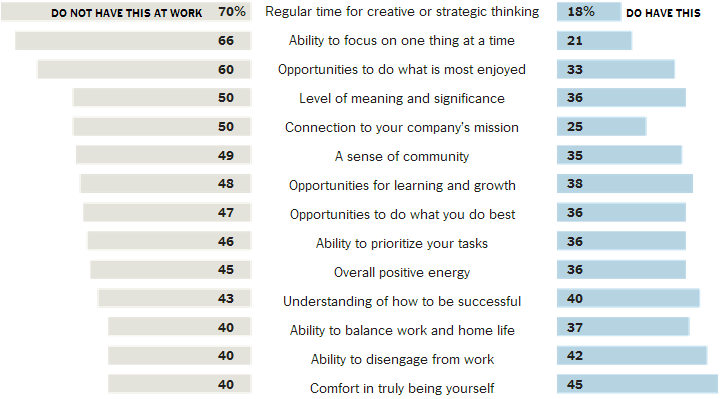
The way we’re working isn’t working. Even if you’re lucky enough to have a job, you’re probably not very excited to get to the office in the morning, you don’t feel much appreciated while you’re there, you find it difficult to get your most important work accomplished, amid all the distractions, and you don’t believe that what you’re doing makes much of a difference anyway. By the time you get home, you’re pretty much running on empty, and yet still answering emails until you fall asleep.
It comes complete with some handy statistics (Source: The Energy Project):
Buy the new Issue Ten in print or PDF today.
Buy the complete back catalogue of New Escapologist with a 10% discount.
Or buy the complete back catalogue on PDF, with £1 off the price each issue.
The Future of Work and Death
Friend Neil directs our attention to this great-looking forthcoming documentary, The Future of Work and Death.
I can hardly wait. Quick, someone throw some money at their kickstarter.
I love that work and death are placed together as discussion topics: the two great so-called inevitables.
This potential film is very much part of our Utopian conversation about what’ll happen when the machines more properly take over and the idea of the human as functionary is more widely accepted as an appalling waste.
Recall this Buckminster Fuller quote:
We must do away with the absolutely specious notion that everybody has to earn a living. It is a fact today that one in ten thousand of us can make a technological breakthrough capable of supporting all the rest. The youth of today are absolutely right in recognizing this nonsense of earning a living. We keep inventing jobs because of this false idea that everybody has to be employed at some kind of drudgery.
Buy the new Issue Ten in print or PDF today.
Buy the complete back catalogue of New Escapologist with a 10% discount.
Or buy the complete back catalogue on PDF, with £1 off the price each issue.
Should I Quit?

I enjoyed this strange little offering from the BBC website: a flowchart for people asking whether they should quit their job or not.
Rather satisfyingly, most routes down the flowchart are in favour of quitting. While just two routes end at “You should stay!”, six lead to “You should go! Good luck!”
There’s also a little bubble statistic on the side of the chart suggesting that “only 37% have a high level of intent to stay in their current job.”
Buy the new Issue Ten in print or PDF today.
Buy the complete back catalogue of New Escapologist with a 10% discount.
Or buy the complete back catalogue on PDF, with £1 off the price each issue.
Coming Up For Air
Coming Up For Air is a wise and beautiful book central to the Escapologist’s library. I read the novel three years ago and today happened upon some quotations from it in my old notebook. Some are pure and giddy fun while others are rather depressing, but they’re all life-affirming in their way.
“There’s something that’s gone out of us. […] It’s a kind of vital juice that we’ve squirted away until there’s nothing left. All this rushing to and fro! Everlasting scramble for a bit of cash. Everlasting din of buses, bombs, radios, telephone bells. Nerves worn all to bits, empty places in the bones where the marrow ought to be.”
“Isn’t it queer how we go through life, always thinking that the things we want to do are the things that can’t be done? It seemed to me a kind of dope-dream, like the ones you have of sleeping with film stars or of winning the heavyweight championship. And yet it wasn’t in the least impossible, it wasn’t even improbable.”
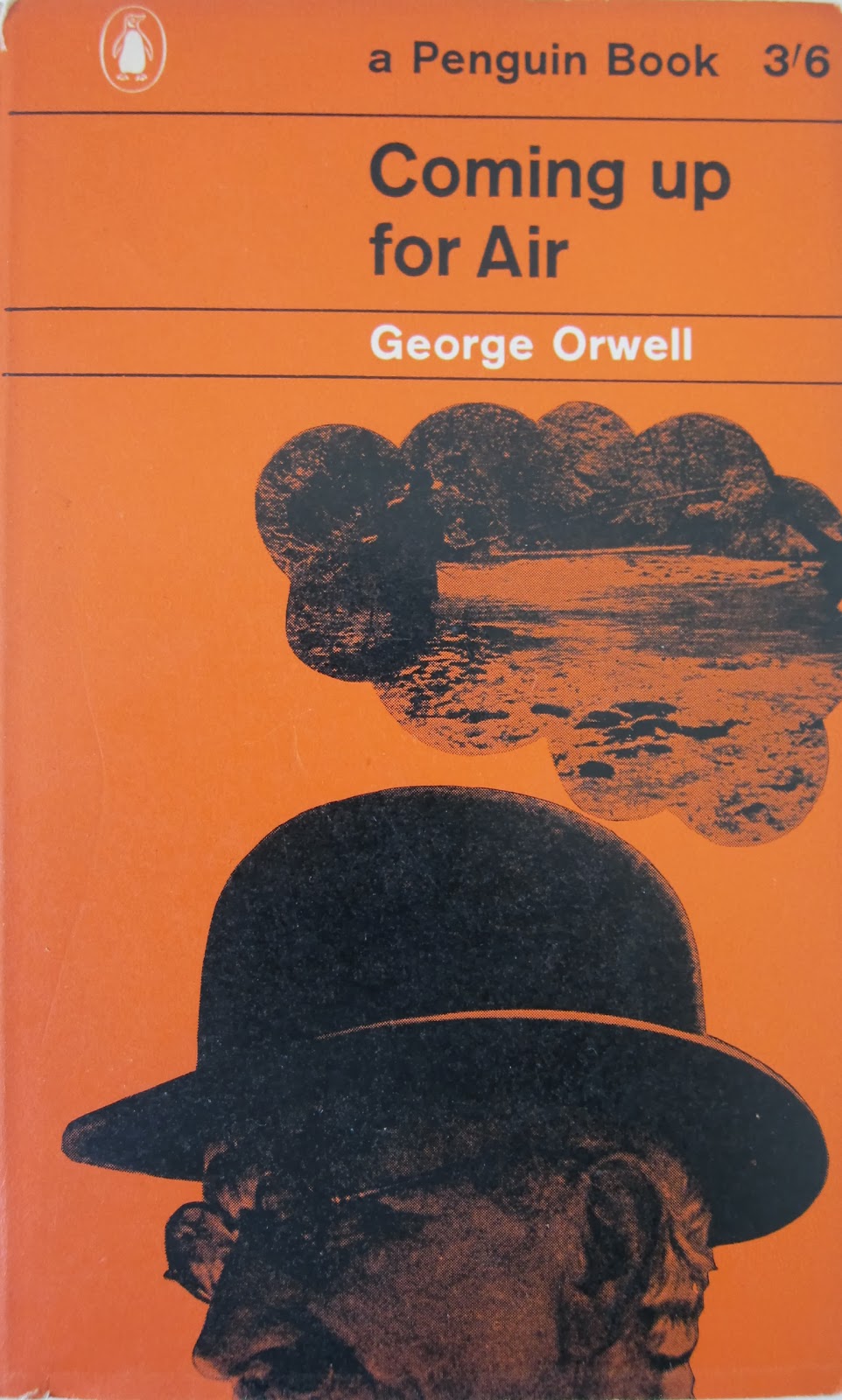
“…in this life we lead – I don’t mean human life in general, I mean life in this particular age and this particular country – we don’t do the things we want to do. It isn’t because we’re always working. […] It’s because there’s some devil in us that drives us to and fro on everlasting idiocies. There’s time for everything except the things worth doing.”
“When I look back I realise that my active life, if I ever had one, ended when I was sixteen. Everything that really matters to me had happened before that date. […] After [taking a job selling insurance] – well, they say that happy people have no histories, and neither do the blokes who work in insurance offices. From that day forward there was nothing in my life you could properly describe as an event.”

“There’s a chap who thinks he’s going to escape! There’s a chap who says he won’t be stream-lined! He’s going back to Lower Binfield! After him! Stop him!”
Buy the new Issue Ten in print or PDF today.
Buy the complete back catalogue of New Escapologist with a 10% discount.
Or buy the complete back catalogue on PDF, with £1 off the price each issue.