The Blurb
Here is what the blurb looks like on the back cover of Issue Five. The reference to Brobdingnag is from Gulliver’s Travels, which remains timeless and inspirational.
Issue Five is available in the shop.

An Escapologist’s Diary. Part 26.
In the New Escapologist survey, our readers’ joint-favourite activity (joint with ‘reading and libraries’) is revealed to be walking. We are a well-read and eternally roaming bunch. As if we needed a survey to tell us that.
What does walking have to do with Escapology? There’s certainly a strong sense of freedom in knowing you have the physical fitness to take flight at a moment’s notice and with minimal assistance. It’s also the cheapest mode of transport there is, meaning less need to sell your time for money. Walking keeps you fit without resorting to the expensive indignity of the gym, and allows you to discover parts of the city you wouldn’t have noticed otherwise: secret alleyways, blue plaques, hidden bars, unusual statues and masonry.
I’m an eternal pedestrian, walking mainly as a way to get from A to B. If ever I resort to the subway or a taxi, it feels like a slight failing. Sometimes I even forget that the subway exists, which is a shame because the one in Glasgow is very charming. Walking, these days, is my primary means of transport.
On rare instances of walking specifically for pleasure, I am likely to do so as an urban flaneur. Unlike the hiker or hill walker, I am not particularly interested in the countryside. I am trying, however, to take a more active interest in walking, and it has inevitably taken me into the countryside. I may have been pulled in this direction by Stephen Barry’s inspiring account of the Rambler’s Association in New Escapologist Issue 5.
Yesterday I walked 23 miles from Glasgow to Loch Lomond. It was training and a fitness indicator for next week’s challenge of walking 41 miles across Yorkshire moorland: the dreaded Lyke Wake Walk, which my dad remarkably completed as a hungover twenty-year-old in the 1960s.
I’ll be doing the Lyke Wake Walk with New Escapologist‘s typographer, Tim. My dad, meanwhile, will be our support team, meeting us by car at each of five checkpoints along the way.
Here’s the report I sent to Tim about yesterday’s walk to Loch Lomond:
Cult of the minimalist glocal
Why does not having much physical stuff make me think I’m some sort of transnational Bourne-like entity, complete with non-ironic personal soundtrack, where for others it means they’re itinerant migrants, or just plain poor? Owning fewer than 100 objects is either a matter of hipster pride, or just, well, poverty. It’s a First World Problem written so large as to be shameful.
Ben Hammersley on the mobile, minimalist lifestyle.
Unused
A friend asked me just now about an unusual context for the word ’employ’. To clear things up, I explained that ’employ’ actually means ‘use’. For example, one employs a hammer to drive a nail.
It struck me as odd that we never hear ‘use’ when someone says ’employ’ in relation to a person’s profession. “I am used by a large software company”. “My husband is used as a secretary”. “My daughter is used on a fixed-term basis”. Doesn’t sound very pleasant does it? Makes one sound like a piece of gym equipment.
Conversely, “I am unused” sounds far more pleasant than “I am unemployed”. I think I’ll start using it! Or rather employing it.
An Escapologist’s Diary. Part 25.
Organising the zine fair was a surprisingly stress-free caper. There are really only three components: venue, audience and contributors. Thanks to the Internet, these things all fell into place quite easily. This can be our little secret though. The event looked very impressive and we’re happy to take any credit that’s going around.
Less easy was the physical work of carrying the all-important trestle tables up the hill from a local church, which Samara and I did together at 10:30 on the morning of the big day. The chap from the church who’d arranged to meet us was amused that a lanky young man in running shoes and a tiny Canadian woman had planned to tackle the whole load alone. True, we’d have done better with more volunteers but it felt too much of an infringement upon various friendships to ask for help at such an intolerable hour. It was only upon Samara’s insistence that I didn’t do the entire schlep on my own. Samara, who is accustomed to much harder work at major art shows (“carrying a bronze sculpture, backwards, while wearing heels” is her job description) made light work of it, but two days later my muscles are still burning from the rare feast of lactic acid.
It was fun (and unusual for me) to scurry around so early in the day with a clear agenda. It felt perfectly symbolic to carry the zine fair tables past the building in which I used to work; my bleary-eyed former colleagues almost certainly labouring quietly within, unaware that I was up to such monkey business. They’d be clicking around on Facebook and drinking poisonous instant coffee, while their one-time water-cooler pal was embarking on an Escapological caper right outside the window.
The zine fair took place at the Free Hetherington, the student-occupied university building I mentioned in my last diary entry. The numbers blue-tacked to the ground floor window declared that it was Day 122 of the occupation. Most of the occupants were at a student protest at nearby Strathclyde University, but a few sleepyheads were still savouring some zeds on the upper floor and two friendly girls were juggling colourful balls on the front step.
After parking the tables at the Hetheringon, we went home for a shower, a rapid lunch and to collect our stock of New Escapologist. We brought an ambitious number of Issue 5s and a smaller selection of back-issues. In the end, I think we sold more back-issues than we sold of the new edition, but these things can never be predicted.
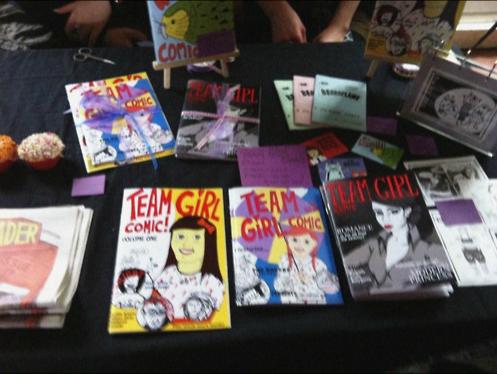
As we cleared the upper floor and began to set up the tables, the other dealers began to file in. Among their number were our friends from Team Girl Comic, Kleinzeit, Lock up Your Daughters and Aye-Aye Books. I was also happy to see Stuart Smith with his back-issues of Beard magazine, about which I am fondly nostalgic.
For posterity, the full list of dealers can be found on our event page at the eternally brilliant Zine Wiki.
Once we were all set up, the rest of the day whizzed by very quickly. Just as I had done at the Montreal Anarchist Bookfair and Expozine last year, I had perfected a little sound bite to describe New Escapologist to anyone browsing the stall. I explained that we are an “anti-treadmill publication with a nice mixture of funny and earnest articles, and with contributors from all over the world”. I don’t know why exactly, but different venues make me want to describe the publication slightly differently. In Montreal, I was keen to describe us as “a humour periodical from England” simply to explain my accent immediately. Here, it felt that the anti-treadmill (education>employment>retirement) angle was the key for some reason.
Lots of pals showed up to support the gig. I was particularly glad to see my comedian friend Ian Macpherson. I had been feeling pretty ragged from the table carrying and magazine touting so I was very happy to see the hangdog chops of this not-quite-fallen-but-hanging-from-a-thread trickster god in our midst. He regaled us with anecdotes about getting his new book published by Rory Bannerman-Coutts, who sounds quite a character.
It was also good to meet Graham Fulton whose funny poetry about office life will make an appearence in Issue 6 of New Escapologist; and two of the librarians from the Glasgow Women’s Library: a cause highly worthy of your support.
As ever at these things, we had to ration the number of publications we bought from other people, lest all of the days proceeds be completely absorbed in the same enterprise. Nevertheless, we bought some of Graham Fulton’s brilliant stuff (a book of poetry about the Glasgow subway system and a single poem about The X Files); New Escapologist contributor Paul Jon Milne‘s zine, Guts Power; issues of Team Girl Comic; and a Lock Up your Daughters to boot. Browsing through the latter, I was surprised to see a photograph of myself! It was this one.
The zine fair was a modest success, I reckon. Big thanks to Tom Coles and everyone at the Free Hetherington.
Today we managed to find the energy to march along with the Slutwalk between George Square and Glasgow Green. You can see my head sticking out of the crowd emu-like in this picture. It looks like I’m talking to myself but I’m actually enjoying a nice conversation with tiny Laura Gonzalez about Momus who we hope to see perform in Edinburgh next week. New Escapologist salutes the Slutwalkers.
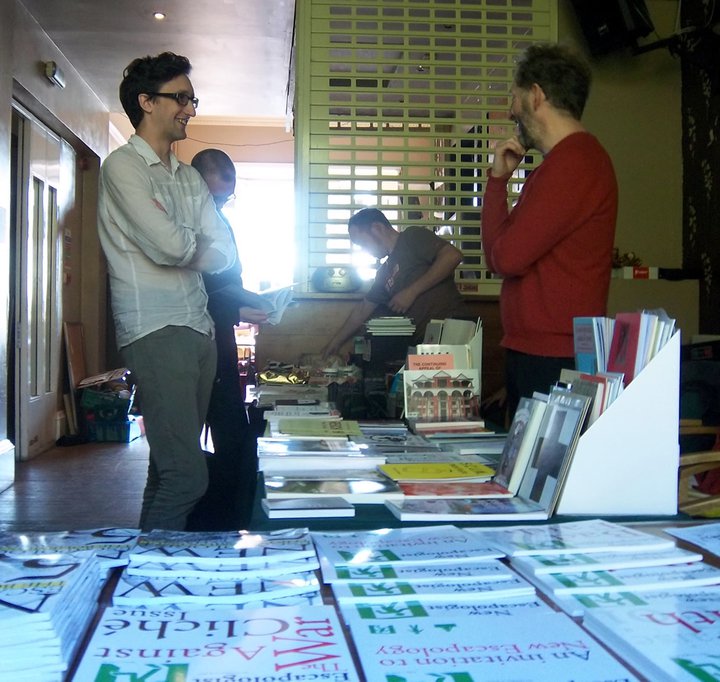
Thanks to Neil for the above pic.
Posters
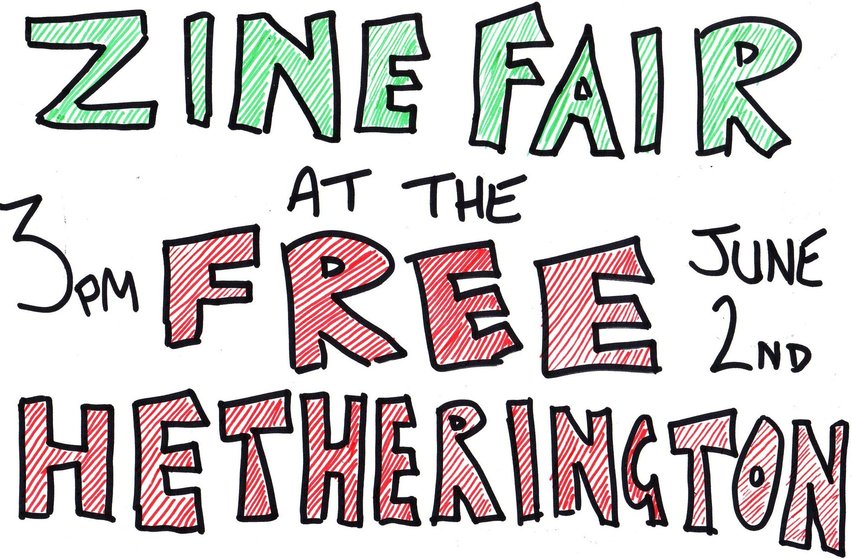
A fun day last week in the Free Hetherington with Samara, Kirsty and Stephen. We drew about thirty posters for our pending zine and indie press fair. Here are my four favourites:
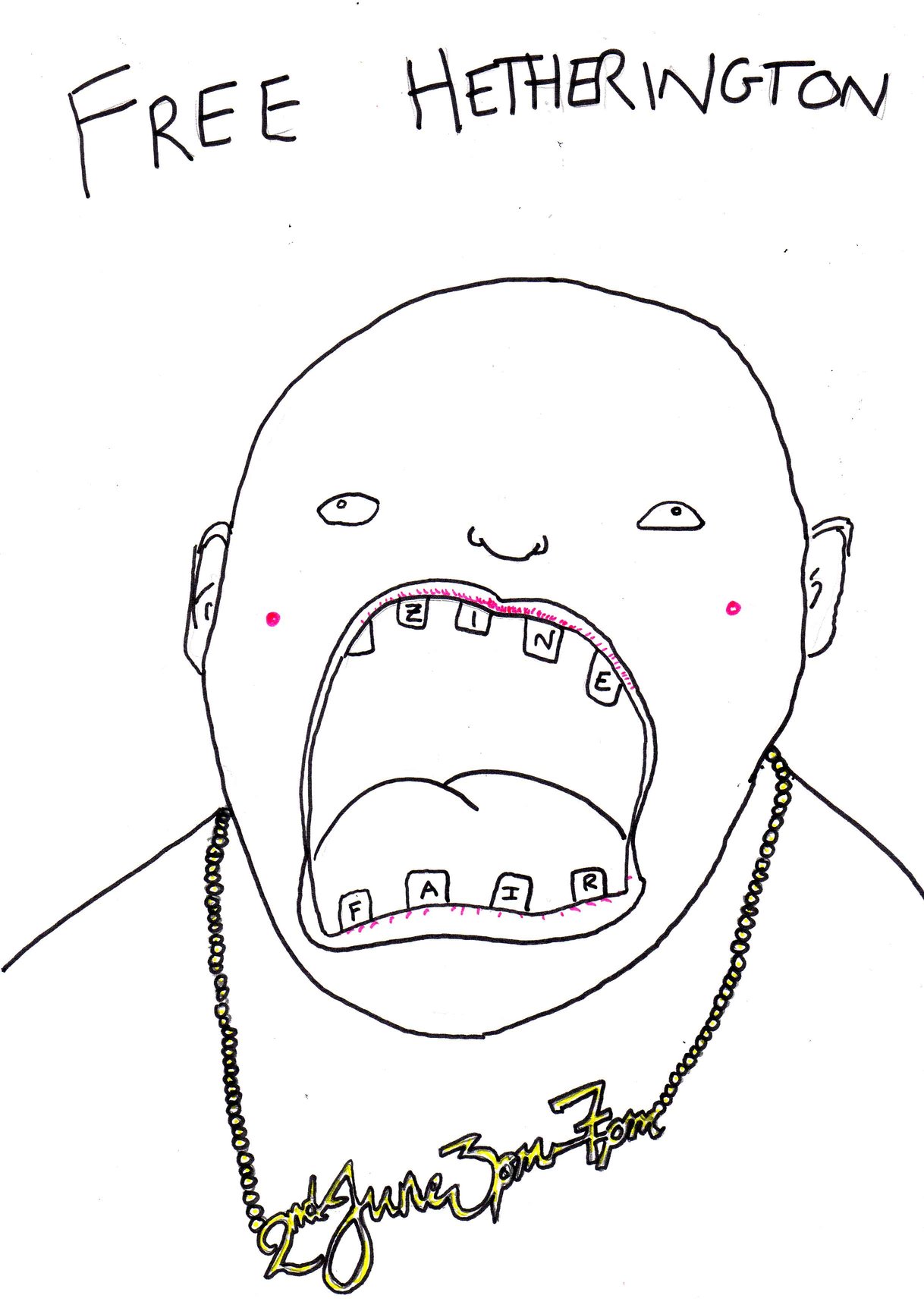
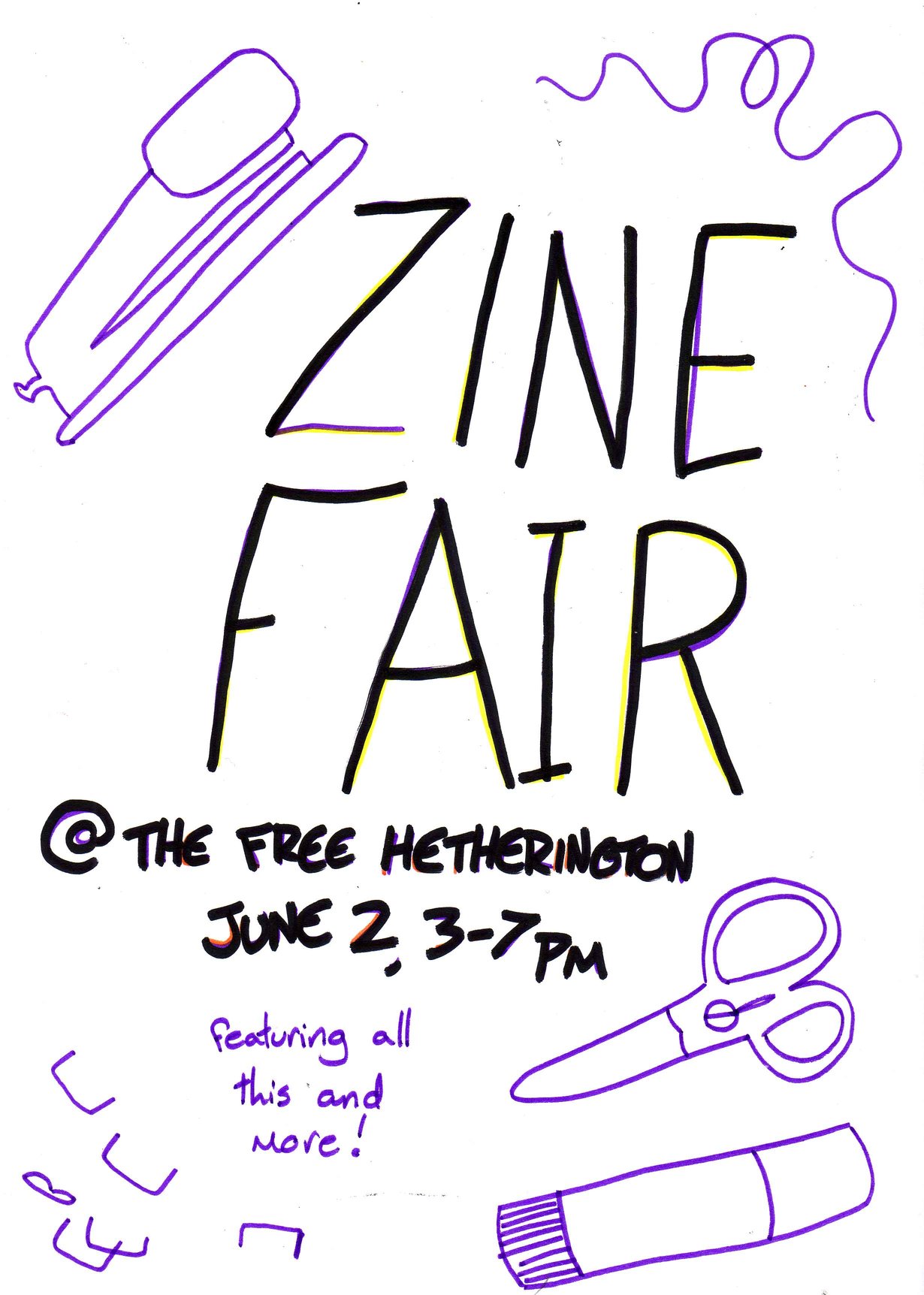
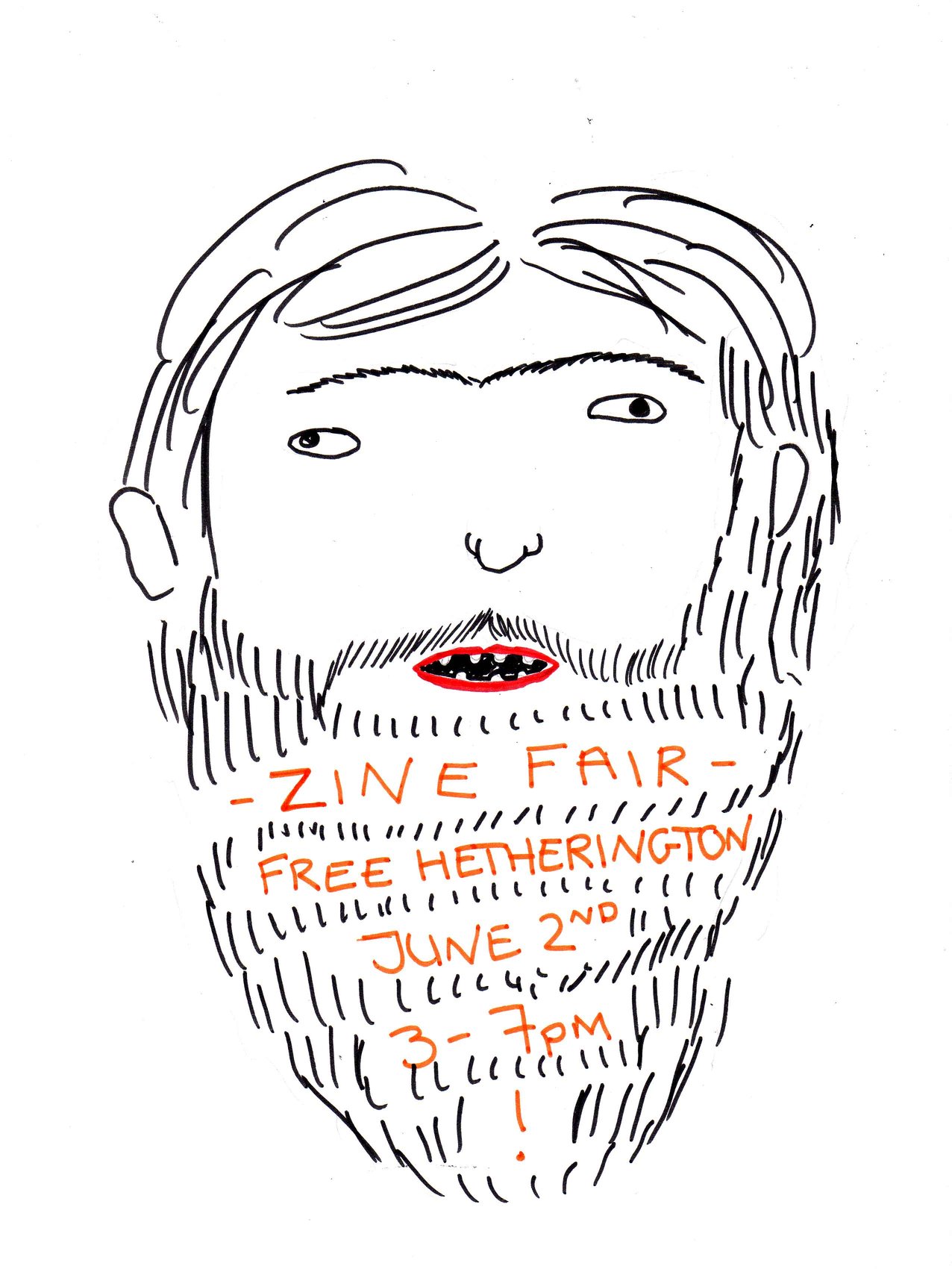

The zine fair takes place from 3pm on Thursday 2nd June. Come along if you’re in the area.
Mind Your Business
 I have a useful essay in the upcoming Idler 44: Mind Your Business. My piece is called ‘The Business of Escape’ and pulls together some of the economic and entrepreneurial ideas covered in New Escapologist 1-5 and learned through my own experience of being professionally on the lam.
As is now traditional (after three years in its current format) the new Idler edition looks utterly stunning with its fine typography and hardback cloth binding. My essay is in good company too, sitting alongside works from Penny Rimbaud and Bill Drummond et al. The Idler is an astonishing annual event. Copies now available to pre-order at their shop.
Eventful
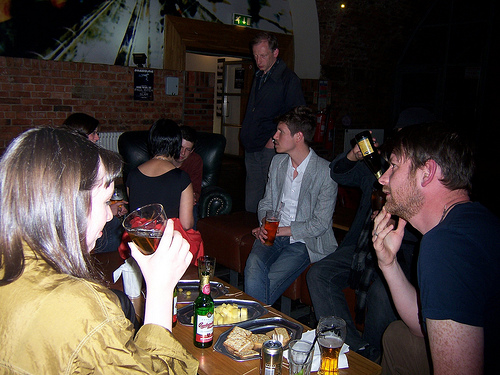
A resounding “thanks!” to everyone who came along to last night’s Issue 5 launch event, and special thanks to Liz and Maria at The Arches for kindly hosting us.
New Escapologist Issue 5 launch event tomorrow
 Just a quick reminder that there’s a New Escapologist gathering in Glasgow tomorrow. If you fancy coming along, we’ll be at The Arches (beneath Central Station) between 6pm and 9pm.
All are welcome. Bring friends. Meet the creative team behind the magazine, mingle with other readers and buy a copy of the mag. Free entry, naturally.
“Foppish, irresponsible, and very needed” – Pat Kane, ThoughtLand
“Excellent publications which deserve a wide readership” – Tom Hodgkinson, The Idler
Collars: a guide
White-collar: the sector concerned with semi-professional, administrative, or sales coordination tasks and endless games of computer solitaire. Employment in this sector leads principally to debt, early rises and the pinning of hopes upon the national lottery.
Blue-collar: the sector concerned with manual labor. Though there are many noble circumstances for this flavour of work, it all too often comes down to sustaining two Capitalist continents of ungrateful and over-privileged skittles who can’t be successfully encouraged not to overfill a kettle.
Green-collar: the brave sector charged with delaying the oncoming environmental collapse.
At last! New Escapologist‘s contributions to the collar-based taxonomic system:
Orange-collar: unpaid interns and reluctant volunteers. The term derives from the satsuma-orange shirt I wore for the duration of my school work experience.
Detachable collar: the sector of society concerned with ‘detaching’ themselves from every flavour of grunt work and career ladder available. It also refers to the extremely practical, eminently stylish, decadent and bafflingly out-of-vogue detachable shirt collar. This is the kind of collar-work for readers of New Escapologist and possibly those of The Chap.