Frugality versus miserliness
In the very first essay of our very first edition, we printed a tabular manifesto of things an Escapologist might want to ‘escape from’ and ‘escape to’.
As a point of interest, this was adapted from an exercise practiced by the English poet, Brian Christian de Claiborne Howard, who originally drew up lists under the headings J’adore and J’accuse. He was in favour of love, food, freedom and art. He was against missionaries and bureaucrats.
One of the things we sought ‘escape from’ was miserliness. Escapologists should not be fiscally mean. Rejoice and be merry. Don’t abstain from pleasure. With time, company, action and thought, be generous to others.
Paradoxically, a key to maintaining a life free from debt and excessive labour is frugality. So how does one resolve frugality with the pledge against miserliness?
1. Frugality doesn’t exactly equate to miserliness. Learning to make your own burger patties or to stoke your own woodfire are frugal activities. It would be incorrect to describe them as miserly. Apollonian, perhaps, but not miserly.
2. Frugality need not exclude expensive purchases. You can afford the finest essentials if you stop buying poor quality things that need to be replaced all the time (highstreet clothes and sweatshop shoes) and things that serve only to distract and rot the mind (computer games, convenience food). The purpose of spending more money on a bespoke suit or the finest beers known to science is that the quality is better and you’ll get more out of them. Remember your quality budget.
3. If money is scarce, there are other things with which you can be generous: time, action, company and thought. Time is abundant when you don’t work, so it’s easier to be generous with it as a successful escapee. Action can be given to assist friends on their projects now that your actions aren’t owned by an employer. Company in the pub should be as inclusive as possible: you might learn something from people from other circles. Thoughts can be shared freely when you don’t need to compete with colleagues for managerial affection: commit your unconventional Escapologist’s mind to mulling over other people’s problems, offering your Jeeves-like miracle solution. Cultivate a generosity of mind: give people the benefit of the doubt.
4. Look for economies of scale to increase the potential for generosity. When a round of drinks in the pub exceeds a day’s income, it is reflexive to balk at such an expense and hard not to feel like a miser for worrying in this way. If, however, you brew five vats of beer in your cellar, you’re unlikely to feel the same pinch when it comes to giving it away. Become a good host. Be the person who welcomes everyone for a home-brewed beer. When the Idler‘s Tom Hodgkinson moved into a big old house in North Devonshire, he converted the scullery into an in-house pub where he shares beer and plays darts with his family and friends.
Brian Christian de Claiborne Howard may have been in favour of love, food, freedom and art but—by necessity, as a lover of freedom—also practiced frugality. He was a Bohemian: one of the truest breeds of Escapologist.
How does one resolve frugal behaviour with a pledge against miserliness? Recognise the difference between the two, look for opportunities to be generous and become a Bohemian.
Castaway on the moon
We saw a Korean romcom last night called Castaway on the Moon: a genuinely funny movie with an Escapological bent.
In it, a debtor attempts suicide by jumping into the Han River. Instead, he ends up stranded on a decorative islet a small distance from the shore. Unable to swim or attract attention, he is forced to live there on his own, cultivating crops with tools improvised from city flotsam. Charming and strangely inspirational.
We saw the film as part of the Fantasia film festival but the entire movie is on YouTube. This version doesn’t have English subtitles but, in the tradition of all good castaway movies, has minimal dialogue anyway. Here’s the trailer:
Algeria, South London, Bad Faith, & Plonk’stalibon
 The following is a guest entry by sociologist and prankster, Wolfgang Moneypenny. He advocates sovereignty for South London. In this post he writes on the topic of Bad Faith: the theme for our pending fourth issue.
Bad faith. I can barely continue. But I must.
Hello. You might well recognise me. I’m a radically free being. And so are you! However. I’m probably more radical and more free than you. But don’t worry. Don’t panic. You can be so too.
Bad Faith, mauvaise foi, has an equivalent in the old edge-of-extinction-bring-it-back-with-EU-funding South London dialect of Transpontongue. That word is plonk’stalibon and means, quite approxiliterally, an inauthentic lack of appreciation in one’s free choice and choice-responsibility. It is believed by etymologists to be the root of “plonker”.
But to really sink our teeth into Bad Faith and what we can learn from it, let me take you back to that less cinematic but more profound Vietnam… An Algerian War of Independence…
A war that is Sartrean in one variety of interpretation. A particularly juicy. flavoursome variety. A variety so splendid that it’s tempting to stick with it. Whilst it’s oh-so-important to appreciate our free choice, too much choice must dualitially be recognised as a bad thing. I’m here to fight the spread of hypercapitalist postmodernity, people!
Algeria et al. did what they had to do. They overthrew, first, their own denial of their free choice, and, in so embracing a vividly nauseous stench of authenticity, inevitably overthrew their imperialist masters, The Bastard French.
Sartre was the hero of this war. Undoubtedly. He had ideas. And words. Some sort of anti-Sartrean movement has insisted on peddling some sort of quote from some sort of Algerian farmer, some sort of “No matter the consequences I will fight to keep my family alive” faux peasant-hero being-in-itself counterrevolutiography. Laughable. Ha ha ha!
Read the rest of this entry »
An Escapologist’s Diary. Part 13.
Resolutions. My resolve to bake fresh bread every couple of days has fallen by the wayside. Not the result of laziness exactly, but a lack of motivation in the face of steep competition: there are just so many Portuguese bakeries and Jewish-style bagel outlets offering cheap and delicious goods nearby.
My resolution to walk everywhere, however, is still in full force. Resolve was tested on Thursday by the prospect of a long walk in the hot sunshine and the knowledge that I’d have to do the very same walk a day later. In the end, I packed a canteen of water and a couple of cookies and walked anyway. I may have failed the bread project slightly but my enthusiasm for walking remains exceedingly intact.
It was a wonderful walk. I was able to observe that the seasons have changed slightly since last week. We must be entering the second half of summer now. Last week was about ants (swarming underfoot and in the air) but this week was about bees (busily commuting from flowering plant to flowering plant). The cicadas have also begun making their impossibly loud noises from the trees. It must have been this time last year when I first heard cicadas in Montreal. It sounded like a powerful electric current, emanating from somewhere unseen in the rooftops. I had stopped in my tracks and my girlfriend had to explain that the noise was the song of a harmless summer insect.
I had taken a slightly different route to usual, going via the main shopping precincts and Quartier des Spectacles. The Quartier is still very much under development and even though I was treated to some live Latin-style music from one of the public stages and saw some Papier-mâché sculptures of Charlie Chaplin and the Three Stooges, I was also accosted by several genuinely desperate-looking homeless people. A teenage boy with a German accent offered to give me a blow job for 25¢, though he may have been joking and I wasn’t sure who he intended to be on the receiving end.
Read the rest of this entry »
Options
I just finished reading a novel by one of my favourite ever writers, Alasdair Gray. The novel is called 1982, Janine. After a long night of introspection and an attempted suicide, the narrator gives himself opportunity to start afresh:
Will I start my own small business, if so what will it be? Will I buy a partnership, if so with who? Will I found a co-operative, start a theatrical company, join a commune? Will I invent something? Will I retrain myself to be a farmer of cattle and crops, a farmer of crabs and kelp? Will I join a political movement? Will I get religion? Will I hunt for women through contact magazines and singles clubs? Will I marry again and have a family this time? Will I emigrate? Will I roam the world with or without a companion? Will I discover that I am a homosexual, a cool-eyed gambler, a carver of clock cases, a psychopathic killer? Will I die in a war, a brothel, a famine, a bar-room brawl or beachcombing in Sri Lanka or in the Falkland Isles or in some other remote souvenir of the Great Britisher’s Empire? For I will not do nothing. No, I will not do nothing.
Later, the narrator is addressed by God (a character in the novel) who says this:
Stand up son. You’ve fallen and hurt yourself, but we all make mistakes. Regard these thirty or so mistaken years as the end of your schooling and start anew. There’s plenty of time. You’re not dead yet. You’re not even fifty.
It’s an astonishing novel, actually. Borrow a copy from your local library or order one from your local bookshop.
On Multitasking
Multitasking is crap. It is better to concentrate fully on one task at one time. By doing so, fewer mistakes are made and a little pride can be taken in a single job well done instead of pride being misplaced in creating an air of manic busyness.
Multitasking is actually a computing term denoting the ability for one server computer to look after multiple other terminals at the same time. But we’re not computers: we’re human beings and our work aught to be more organic, more considered and less complex.
Lets slow down an address one task at a time. This is a far more simple approach to work than multitasking. We’re even encouraged to multitask in our leisure lives. People on TV, when in relaxation mode, usually listen to music and read books at the same time. Captain Picard likes to listen to opera and read Shakespeare simultaneously. Frasier and Niles drink coffee as they go. Superman dashes all over Metropolis with four rescue missions on his mind at the exact same time, while also hobnobbing at a Daily Planet cocktail party. Maybe the Man of Steel can afford to multitask but your work probably doesn’t involve saving the planet from criminal geniuses and you don’t have alien superpowers working in your favour.
A pertinent symbol of multitasking is a takeout coffee cup with a plastic lid. They are designed so that you can drink your latte while dashing from one meeting to another, or so that you can knock back your Americano as you tap away at the monthly progress report. Would it not be better to slow down? Take half an hour (Hell, take an hour) to go to a coffee shop and enjoy your beverage properly and in a real cup. You’ll feel better for it. Write your report later and give it your full attention. Multitasking requires more energy than tackling one job at a time. With multitasking, you have to plan; you have to think ahead; you’re flying by the seat of your pants. It is complicated. I doubt it’s healthy either since you’re forced to cut back on those little sub-activities that make you human: daydreaming for instance or eating properly.
What happens when you plug four separate devices (an iPod; an internet connection; a Dictaphone and a digital camera) into a computer? It slows down. It crashes. It burns out.
Take one thing at a time.
Interview with James Mallinson
I hope you’ve been enjoying the recent blogger interviews. While a lot of these guys don’t claim to have all the answers or to have properly escaped yet, they’ve often put more thought into the escape question and ‘how to live’ than the typical person on the street. I should also point out that their opinions are often different from those held in the manifesto of New Escapologist but it all contributes to the discourse around alternative ways of life.
The following is an email interview with James from Part-Time Wage Slave.
Do you believe freedom is the natural state or a modern privilege?
True freedom as defined in a dictionary is impossibly hard to achieve in a modern society, so in that regard it’s a natural state. So, do we really crave freedom? Do we really want to live in a world devoid of regulation and law and obligation? Having to pay taxes is far from the notion of freedom in a traditional sense, but in return we get a police service, hospitals, etc. You could at any time, sell your home and your clothes and go travelling, but you couldn’t go robbing somebody in order to fund that travelling. The modern ideal is then perhaps freedom with fair boundaries or conditions attached in order to have a system that is stable, and in that regard it certainly is a privilege because there are many, many countries out there whose ‘boundaries’ on freedom are vastly more restrictive and anything but fair.
Read the rest of this entry »
Interview with Carlos Miceli
As the result of some matchmaking by a mutual reader, I conducted an email interview with Carlos Miceli from Owlsparks, a blog dedicated to discussion around ‘realistic happiness’. Carlos has recently relocated from Argentina to Australia but was was nonetheless generous with his responses:
Do you believe freedom is the natural state or a modern privilege?
Some months ago I finally watched The Shawshank Redemption and it made me think: “Man, we sure underestimate our freedom…” But it’s important to define it first. IF we’re talking about the freedom to go wherever we go, do or say whatever we want, then yes, I think it’s fairly new. It’s so new that some people still don’t have it.
However, when we analyze freedom, again, from a more realistic point of view, we realize that we are not as free as we think. Otherwise we wouldn’t have so many people hating their jobs, their spouses, their cities and more. Real, pure freedom is frightening. Like I said on a recent post, we don’t want (or have) freedom. We just want some wiggle room.
Read the rest of this entry »
Issue Four: a sneak preview
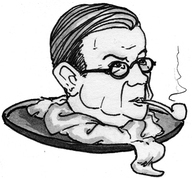 Most of the content for our latest printed edition, Issue Four: the Mauvaise Foi Issue has been received and the editing process has begun.
There are some excellent essays in this issue, and it’s been especially fun to return to a more esoteric style after the practicalities-orientated approach of Issue Three.
The content of Issue Four looks something like this:
– Editorial: For Madmen Only (Robert Wringham)
– The Bad Faith of beach holidays (Tim Eyre)
– How to rewrite your script (Neil Scott)
– The Catholic Worker Movement (Tom Mellors)
– Neuro-Linguistic Programming (Matt Caulfield)
– How to use a library (Rob Westwood)
– Reclaim the Fluchtverdächtiger (Robert Wringham)
– Nothing but time: vagabonding with a young family (Stephen Barry)
– Citizen’s Income (Sam Nair)
– Escaping Distractions (Neil Scott)
– The road to Auschwitz (David M Gross)
– When my will wouldn’t (Ishmael Gradsdovic)
– On Running (Jonathan O’Brien)
– Please shop responsibly (Samara Leibner)
– It’s the little things (Shanti Maharaj)
– How I trumped Bad Faith and quit my day job with three emails (Jon Ransom)
– Mauvaise Foi comes to Busytown: a fable (Robert Wringham)
– Filling the void (Robert Wringham)
– Title TBC (Fabian Kruse)
– In Sickness & in Health; A Study of Three Poor Men: Flaubert, Sartre & Myself (Reggie C. King)
Of course, some of these titles will seem mysterious now. You’ll have to wait for the issue’s release to see what they’re all about.
Issue Four will be released officially on 16th August. Early orders (including subscriber and contributor copies) will be shipped on the same day. To pre-order (or to buy back issues and subscribe), visit our online shop.
“But I need it!”
I have a new catchphrase to make my girlfriend laugh. Whenever she asks me to refrain from something, I petulantly say, “But I need it!”
For example, if she wants me to switch off the air conditioner in our apartment, I adopt a non-negotiable tone and say “But I need it!”.
This probably isn’t funny to anyone else in the world. It only works here because my girlfriend knows me very well as someone who doesn’t need much of anything. The suggestion that I, of all people, need the air conditioning on full-blast is very funny to her because of certain tendencies central to my character:
– I am more inclined to adapt to an environment than to look for ways to neutralise it. To run with the example of air conditioning, I’m likely to ‘sweat it out’ for as long as possible before cranking up the AC. I think this stems from a childhood inability to deal with hot weather and a desire to overcome the problem rather than spend a lifetime complaining about it, seeking pity and pragmatically dealing with it on a day-to-day basis. If you can convince your body to survive in different terrains and climates, you’ll be less dependent upon the absurd levels of comfort to which we have access today, and consequently be more mobile. You won’t say “I can’t” [work in a bakery, read in the hot park, visit Africa] because of the heat. Banish your intolerance to temperatures, weather conditions, heights, pollens, other languages or cultures. Through adaptation, you will be defeated by fewer things.
– I am happy for people to borrow (and even keep) pretty much anything I own. If someone wants to borrow a book, I usually invite them to keep it. It’s better to be generous with such things: doing so eases the burden of ownership on myself, makes a friend happy and increases generosity of mind. Saying “But I need it!” is very alien to my character.
– I wrote an article on ‘escaping dependencies’ in New Escapologist Issue 3. In it, I advise people to kick soft addictions such as coffee or television and offer neuro-linguistic techniques (courtesy of our happiness editor, Neil Scott) to help them achieve this. I’m pretty good at escaping dependencies and very unlikely to say “But I need it!” in relation to the bag of doughnuts my girlfriend invited me to share yesterday.
This post isn’t intended to be an egocentric babble about how great I am and how virtuous my character is. I just wanted to write about the satirical value of “But I need it!” and the prerequisites required if you want to use it yourself.